

November 29, 2023, 2:48 pm | Read time: 6 minutes
In the early 1990s, one of the most ambitious experiments of all time made headlines. In “Biosphere 2,” essentially a miniature Earth under a glass dome, eight people lived and conducted research for two years. However, the scientific dream was essentially doomed from the start–and ultimately ended with a spectacular collapse.
Imagine for a moment that there was a second Earth. A blue planet in miniature, where future life models could be explored and, ideally, even the colonization of space could be planned. A place where humans and animals could live completely self-sufficiently, isolated from the outside world. Well, such a place did exist once. It was called “Biosphere 2″–and it is perhaps the most spectacularly failed scientific experiment of all time.
According to the New York Times, the dream of a second Earth first took concrete form in 1984: Back then, a group of former hippies, in collaboration with Texas oil billionaire Ed Bass, announced the construction of an airtight ecosystem. The inhabitants were supposed to produce their own food and breathable air using various biomes within the biosphere. The project aimed to provide insights into how the “real” Earth could be saved in an emergency–and, if Earth’s demise could not be prevented, what life in space might look like.
The Salvation of Humanity
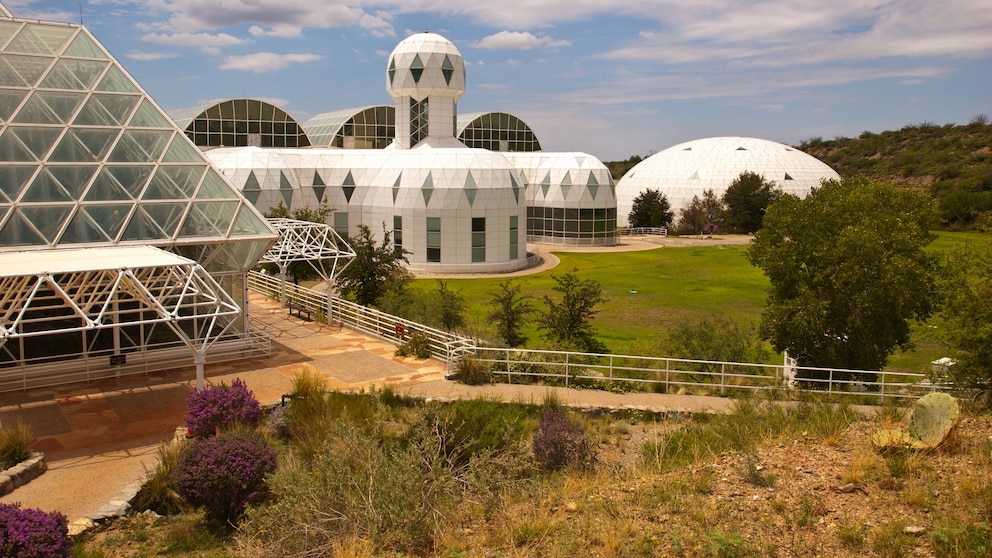
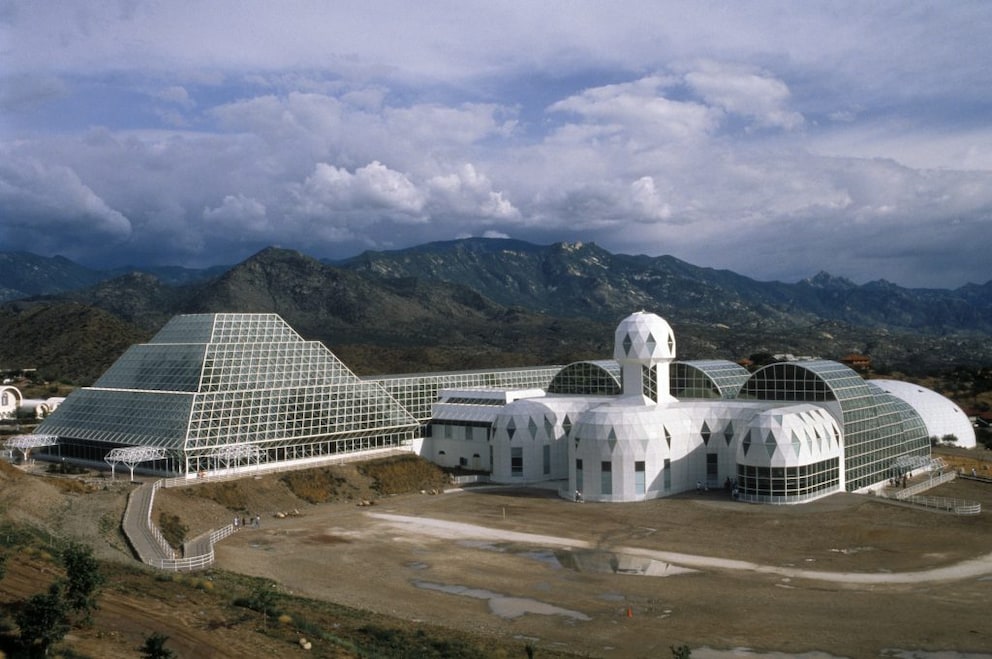
Newspapers called it “the most prestigious research project of all time” and speculated that it could indeed save humanity. No expense or effort was spared. In the end, “Biosphere 2” emerged in the Arizona desert as a truly futuristic research station: 17,000 square meters in size, costing 150 million euros. Complete with its own miniature ocean and rainforest, mangroves, and desert in small scale. Eight selected bionauts were to inhabit this place for two years and gather scientific insights.
Also interesting: Riems: Germany’s most dangerous island
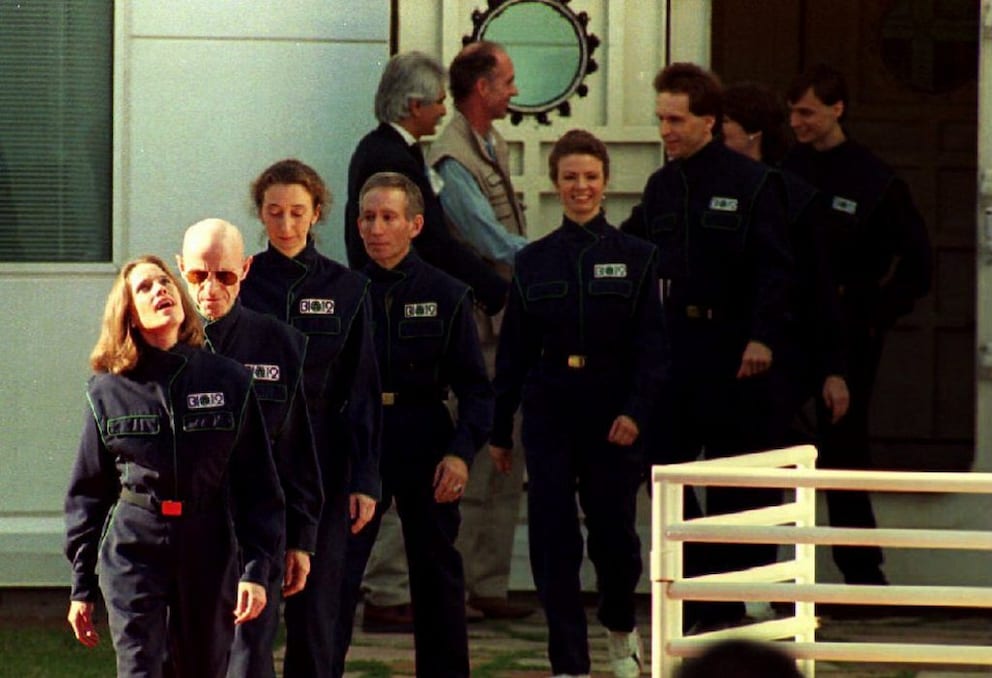
On the morning of September 26, 1991, the eight crew members moved into their new home, after being sent off the night before by 2,000 selected guests with a lavish party. “Biosphere 2” had sparked a massive hype, from which its creators hoped to benefit not only scientifically but also financially. Thus, the research work was under constant observation from busloads of tourists brought to the site daily. While they couldn’t enter the biosphere, they could watch every movement of the people under the dome through the glass. According to the Guardian, even the world-famous primatologist Jane Goodall visited.
Malnutrition and a Severed Fingertip
Inside “Biosphere 2,” the crew soon faced numerous challenges. Shortly after the start, the eight researchers suffered from malnutrition because the miniature Earth did not yield enough harvest. Two weeks into the experiment, according to the New York Times, a female crew member severed a fingertip, requiring medical attention outside the dome. When she re-entered the research station, management had given her numerous technical devices. The ambitious project of complete self-sufficiency was thus quickly abandoned.
Later, journalists uncovered that this was far from the only “cheat” used to assist the bionauts. Additional food was smuggled in twice a month, along with vitamin supplements and plant seeds to keep the fragile flora of “Biosphere 2” alive. Most significantly, a CO₂ filter had been installed beforehand, as the atmosphere in the dome was unstable from the start. Due to this “doping,” the experiment of an autonomous second Earth was essentially doomed from the beginning.
Air Shortage and Species Extinction
Soon, oxygen became scarce. While it makes up 21 percent of the normal Earth’s atmosphere, it dropped to 14 percent in “Biosphere 2,” according to the Guardian. The researchers could no longer breathe properly. Properly performing the hard physical work was out of the question. Some crew members even suffered from sleep apnea, or temporary breathing cessation. Unsurprisingly, morale within the group soon plummeted, and two hostile factions formed.
Also interesting: 11 places worldwide that no one is allowed to visit
Only with the help of artificial oxygen supply could the experiment be saved at all. “Biosphere 2” could never produce it in sufficient quantities on its own. Many animal species in the dome quickly died, including bees and hummingbirds. This made natural pollination of plants and future harvests impossible, as reported by the New York Times. Additionally, the plants were infested by nematodes and mites. Cockroaches spread rapidly.
The Abandoned Underwater Village Where People Once Lived
Stay Overnight in This Former East German Bunker
A Historic Break-In
It is all the more astonishing from today’s perspective that the eight crew members of “Biosphere 2” actually endured under the dome for two years, until 1993. That same year, a new leader took over the highly deficit project: then-investment banker Steve Bannon, who would later gain a controversial reputation as an adviser to Donald Trump. For a short time, it even seemed as if the experiment on the second Earth could somehow be salvaged.
A second crew moved in–this time consisting of seven members. At that point, no one knew that the story of “Biosphere 2” would soon be over. On the morning of April 4, 1994, the research station experienced one of the most spectacular break-ins in the history of science. Responsible were Abigail Alling and Mark Van Thillo, both members of the first bionaut crew. They breached the airtight seal of the dome and destroyed glass panels before being arrested. They claimed they feared for the safety of the people inside the biosphere. Five months later, the experiment was finally abandoned.
Also interesting: Is the mystery of the Bermuda Triangle finally solved?
Not Completely Failed
Despite spending 200 million dollars, it was not possible to produce enough oxygen, drinking water, and food for eight people within the biosphere. The dream of future stations on the moon or even Mars, which was boldly proclaimed at the start of the project, was thus shattered. One of the most tragic circumstances in hindsight is that nearly all the research data recorded in “Biosphere 2” has disappeared today.
Shortly after the failure, Columbia University took over the management of the station until 2003. Since then, the project has been under the administration of the University of Arizona.
And although the original goal was not satisfactorily achieved, “Biosphere 2” cannot be dismissed as a complete failure. In June 2000, researchers from three different U.S. universities published a highly acclaimed study on ocean acidification due to CO₂, conducted in the biosphere’s miniature ocean. The harmful effects of carbon dioxide on coral reefs were also studied in the biosphere. Research continues in “Biosphere 2,” including studies on water flow in soil. At the same time, the site remains a tourist attraction: Every day, numerous people visit the now freely accessible facility to see the place that once held humanity’s hope for a second Earth.