

November 13, 2025, 1:05 pm | Read time: 5 minutes
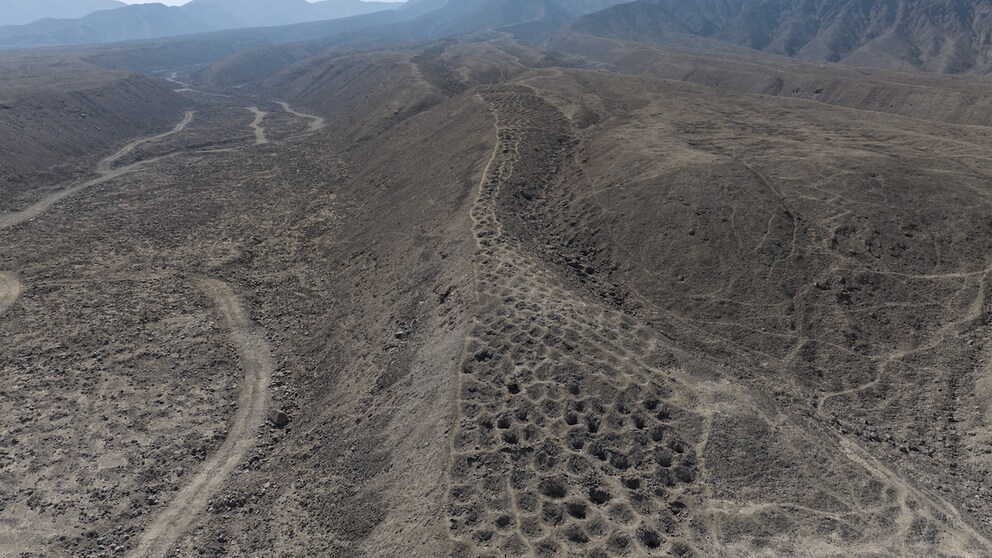
For decades, the so-called “Band of Holes” in southern Peru puzzled researchers. Now, there are new insights into the collection of thousands of systematically arranged pits that stretch along a 1.5-kilometer-long embankment path through the Andes.
In the southern Peruvian Pisco Valley, 5,200 holes have long raised questions. Is the so-called “Band of Holes” or “Pisco Stripe of Holes” on Monte Sierpe (Serpent Mountain) a former defense structure or graves? Were the gods at work here? The theories and myths surrounding the South American structure are varied. Now, an international research team believes they have come closer to solving the mystery. The team, led by archaeologist Jacob L. Bongers from the University of Sydney and anthropologist Christopher A. Kiahtipes from the University of South Florida, recently published their findings in the archaeology journal “Antiquity.”
Overview
What was the “Band of Holes” built for?
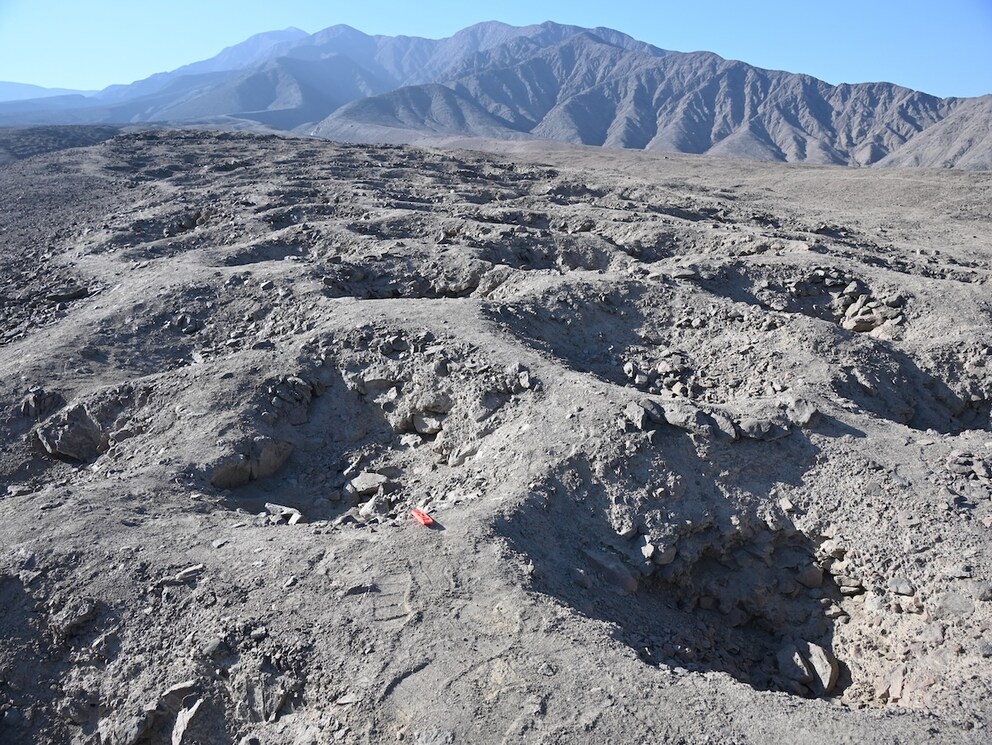
Monte Sierpe is a 1.5-kilometer-long, artificially constructed earthen wall in the coastal desert of southern Peru, about 35 kilometers from the Pacific coast. The wall is between 14 and 22 meters wide and fascinates due to its sections of holes dug into the sediment. These holes have diameters between one and two meters and are between 0.5 and one meter deep. Some are lined with stone walls, as the authors write. The site also includes a “26-hectare defensive settlement located one kilometer east of the depressions” and is situated at “the intersection of a network of pre-Columbian roads (…), between two Inca administrative centers: Tambo Colorado and Lima La Vieja.”
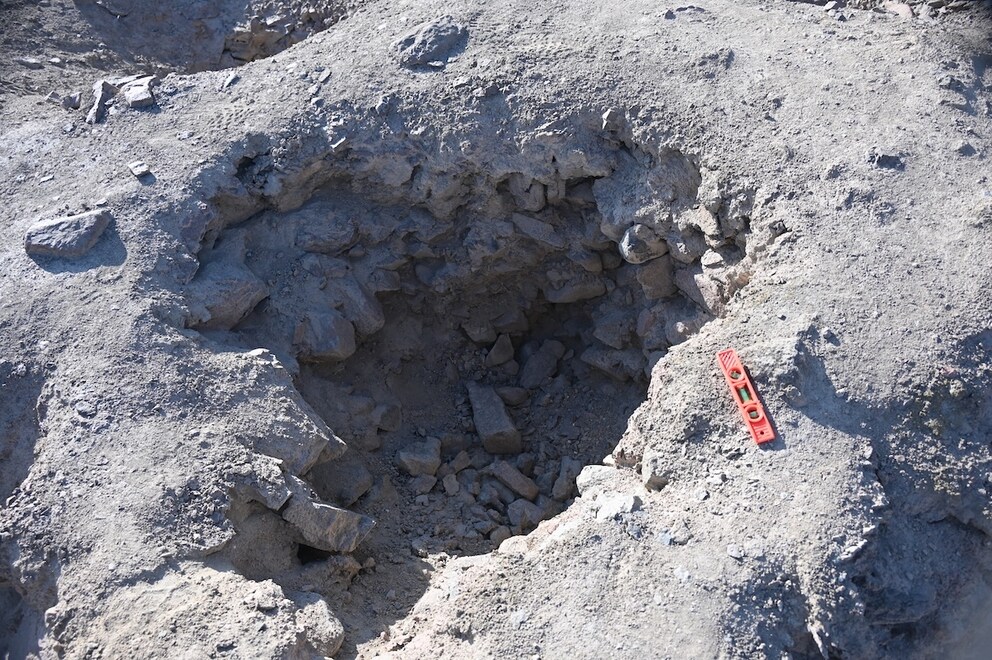
The Serpent Mountain with its thousands of precisely arranged holes likely dates “at least from the Late Intermediate Period (1000–1400 AD) and was further used by the Inca (1400–1532 AD),” the researchers write in their article. Thanks to new analyses of drone images and sediment samples at the Peruvian site, they concluded that “Monte Sierpe served as a local, indigenous system for accounting and exchange,” according to the article.
Monte Sierpe as a trading market
Due to its strategic location, Monte Sierpe was a place “where different communities and goods could be brought together,” the researchers write. The edges of the pits are walkable, and there are gaps between the sections, allowing access. Microbotanical remains also suggest that “the pits may have been regularly lined with plant material and goods deposited in them,” the authors write. These were then transported using woven baskets or bundles.
“We assume that the site originally served as a trading market under the Chincha Kingdom,” they write. Between 1000 and 1400 AD, the Pisco Valley and the neighboring Chincha Valleys were under the control of the wealthy kingdom. “Trading markets are found throughout the pre-modern and non-Western world,” the authors explain, adding: “These are places where goods are exchanged directly without money.” This worked through units of equivalence and accounting. However, the markets were far more than just trading places. Rather, they showcased the full spectrum of social interaction, as well as strictly ritualized behavior patterns.
Also interesting: Where South America remains dangerous–and where it is becoming safer
The Northernmost Castle Complex in Germany Is Located on the Island of Sylt

Researchers Discover More Than 30 Shipwrecks in Lake Constance!
Inca site of accounting
Over time, Monte Sierpe likely “developed into a place for receiving and distributing tributes and other goods within the Inca Empire,” the article states. The Inca took over the area in 1400 and controlled it until 1532, after which it fell to the Spanish, who cultivated wine here during the colonial period.
The researchers suspect that after its integration into the Inca state, Monte Sierpe was also “integrated into the Inca system of exchange and tribute collection” and served as an accounting tool. According to the authors, the Inca had a system called Mit’a, where communities regularly provided labor services or tributes. In the region around Monte Sierpe, this meant, for example, that parts of the yields from the cultivated fields were first stored and later transported to other locations. The individual communities were systematically recorded. To capture various data such as population numbers, tributes, or inventory, the Inca used complex knotted cords called Khipus. Monte Sierpe could thus have been used for counting and sorting various goods.
According to the journal article, “the segmented and regular arrangement of the holes in Monte Sierpe” is similar to that of a complex Khipu excavated near Pisco. This shows “a complex network of arithmetic relationships,” suggesting that it is indeed evidence of the Inca’s accounting processes. The researchers believe that this may have also influenced Monte Sierpe.
Also interesting: Is Machu Picchu losing its status as a “new wonder of the world”?
Research not completed
Monte Sierpe has long occupied researchers. For instance, the National Geographic Society published aerial photographs of the so-called “Band of Holes” as early as 1933. However, the research on the “Band of Holes” is far from complete, despite the latest findings. Rather, they serve as a basis for future research, according to the “Antiquity” article. Planned are test excavations, additional radiocarbon dating, sediment analyses, and studies of other local Khipus. The ongoing research is of crucial importance, also “to counter the pseudo-archaeological narratives that continue to surround the local heritage,” the researchers explain.