

July 31, 2025, 11:13 am | Read time: 3 minutes
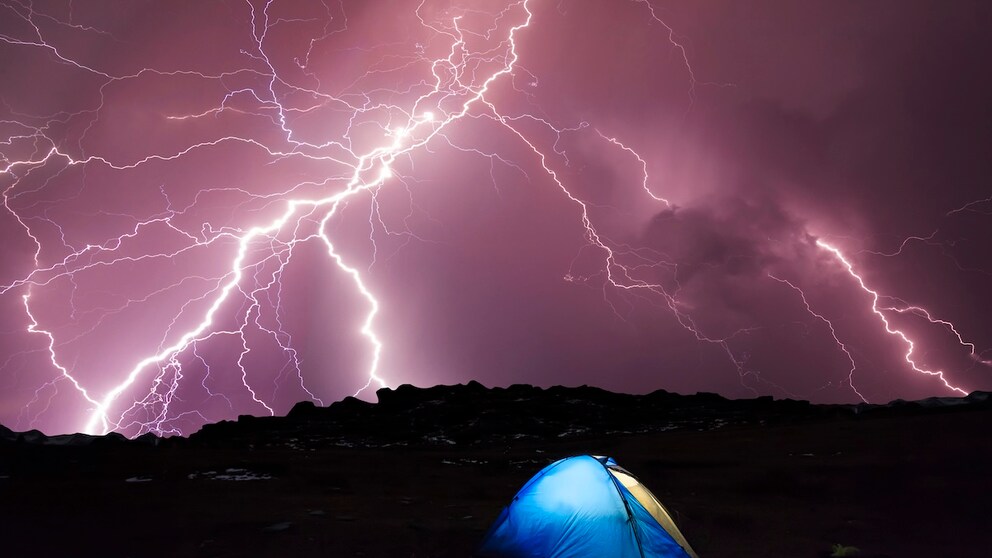
At the Wacken music festival, metal fans were advised to leave their tents as a precaution due to a thunderstorm. Why can it become so dangerous inside them?
When the campsite turns into mud rather than a place due to rain, and lightning and thunder are added to the mix, a tent is not a safe place. Especially when the storm warning already means “danger to life and limb.”
In fact, a tent offers no protection from a direct lightning strike during a thunderstorm, according to the Lightning Protection and Lightning Research Committee of the VDE Association for Electrical, Electronic & Information Technologies.
Camping During a Thunderstorm – What Experts Advise
Therefore, you should leave the tent before the storm and, if possible, seek shelter in a vehicle or building, advises the ADAC in its “PinCamp” magazine. If that’s not possible, the following applies:
- Do not touch the tent wall and tent poles, even if the storm is raging
- Crouch in the middle of the tent – as far away from the tent poles as possible
- Under no circumstances sit on the bare ground; instead, sit on a dry air mattress or a camping cot with a metal frame, avoiding contact with the metal and the ground
- According to the VDE, “Isomats” do not offer protection against lightning strikes
- Remove power cables and other cables leading into the tent
- Remove plastic plates or rubber caps at the pole feet for better grounding

What you definitely didn’t know about airplanes

Why You Should Wear Sunscreen on Airplanes
Why Is Camping So Dangerous During a Thunderstorm?
Lightning strikes the metal frame, can jump over or penetrate insulated areas – such as the tent floor – and usually discharges unevenly through the tent poles into the ground. This creates so-called voltage funnels in the soil around the tent poles, posing a risk of step voltage.
Additionally, there is a danger for people near the lightning-conducting frame: If the human body is better grounded than the adjacent tent pole, a spark can jump and cause a current to flow through the body.
Never Pitch Tents in Exposed Locations
The lightning protection experts of the VDE also recommend campers take preventive measures:
- Never set up tents, caravans, and trailers in exposed locations, such as on hills, directly next to poles and masts, at the edge of forests, or under solitary trees
- Maintain at least three meters of distance from neighboring tents and camping trailers
- Never run metal guy wires between tents or camping trailers
With material from dpa