

August 31, 2026, 3:13 pm | Read time: 4 minutes
The Amalfi Coast is one of Italy’s most famous travel destinations—and one of the most visited. For those seeking more authentic coastal landscapes, historic fishing piers, and relaxed coves, the Adriatic offers a surprising alternative: The Costa dei Trabocchi remains pleasantly undiscovered, rougher, and less staged than its famous Mediterranean sister—and perhaps that is its greatest luxury.
The Amalfi Coast is undoubtedly beautiful. But those who travel there in the summer share the famous view of steep cliffs and pastel-colored houses with many others. The roads are crowded, accommodations expensive, and even getting a photo without strangers requires patience. The Italian way of life sometimes surprisingly fades amid tour buses, traffic jams, and queues.
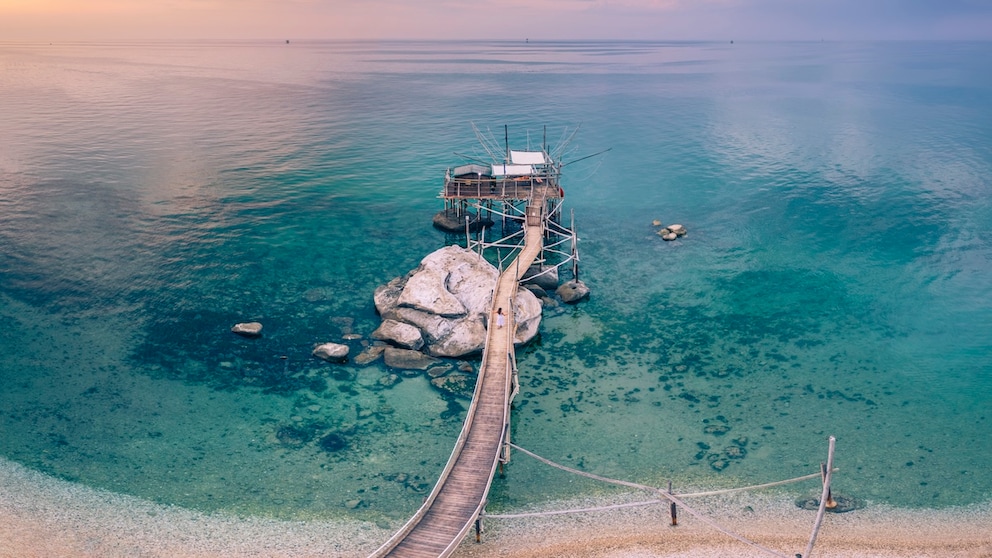
Yet, there is a coast in Italy that is just as impressive but still under the radar for many travelers. Not in the well-known west, but on the Adriatic, in Abruzzo. The Costa dei Trabocchi is often called the “forgotten coast.” Some even refer to it as “the Bali of Italy.” A comparison that sounds grand at first, but makes sense when you see its unusual structures in the sea.
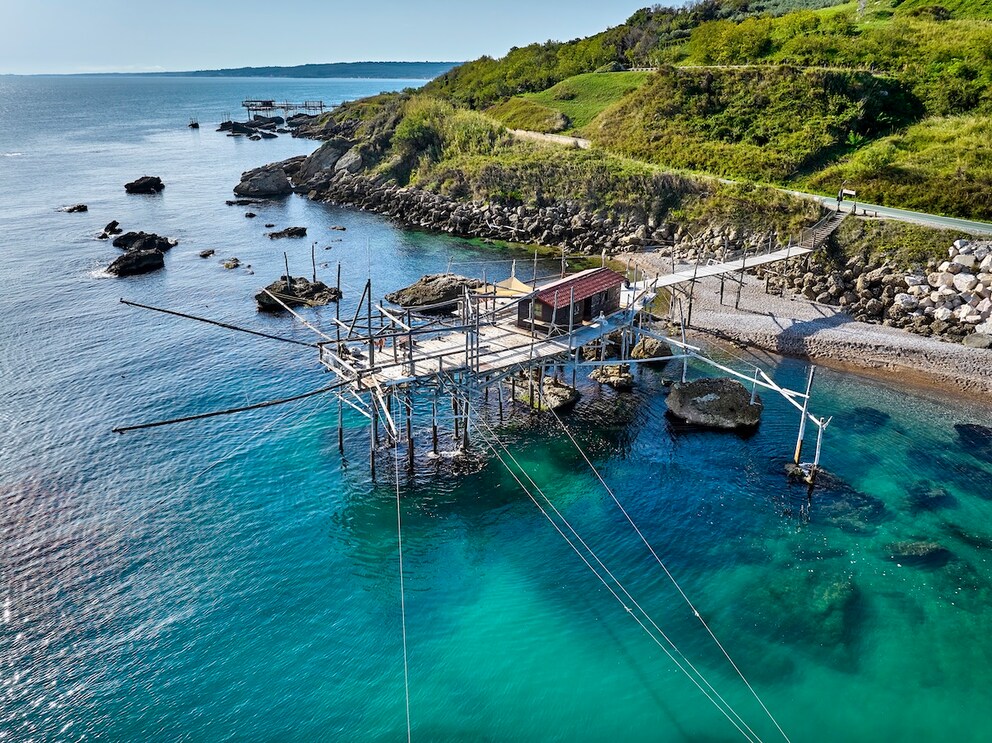
The Costa dei Trabocchi stretches about 70 kilometers through the province of Chieti, south of Pescara. Instead of chic promenades and spruced-up coastal towns, small coves, bright pebble beaches, and green hills shape the landscape. The Adriatic water here is often surprisingly clear, at some points almost turquoise.
New Restaurants on Old Fishing Piers
The main attractions, however, are the trabocchi. These historic fishing structures stand on stilts over the water and are connected to the land by narrow wooden walkways. Long booms extend over the sea. Large nets were once lowered from them, allowing fishermen to haul in their catch without needing to go out in a boat. The first of these structures dates back to 1627.

Today, most trabocchi are no longer used for fishing. Many house restaurants where almost everything revolves around fish and seafood. Dining takes place just a few meters above the Adriatic, with waves moving beneath the wooden planks.
However, planning such an evening spontaneously is not advisable. During the high season, the few tables are often booked well in advance. Making a reservation a few weeks before your visit is therefore wise.
11 of the Most Beautiful Beaches in Liguria
12 of Italy’s Most Beautiful Beaches
Natural Beaches Instead of Rows of Loungers
Even away from the trabocchi, the coast feels pleasantly unhurried. Around Vasto lies Punta Aderci, one of its most beautiful natural areas. From the cape, the view extends over the Adriatic, on clear days reaching the mountains in the hinterland.
Below, paths lead to open beaches and small coves. Punta Penna is expansive and sandy, while Mottagrossa and Spiaggia dei Libertini are characterized by pebbles. Beach bars, tightly packed loungers, and loud music are often absent here. Instead, there is space, clear water, and the feeling of having discovered something on the Italian Adriatic. Several beach sections also carry the “Blue Flag,” awarded for good water quality.
Cycling Along the Sea
The region is particularly well explored by bicycle. The Via Verde runs along a former railway line, free of car traffic, directly along the coast, and is part of the 131-kilometer “Bike to Coast” route. Along the way, beaches, small towns, and trabocchi by the water appear again and again.

The appeal lies less in covering as many kilometers as possible—it’s much nicer to just set off, jump into the sea along the way, and stop where a free table or a quiet cove awaits.