

March 17, 2026, 9:56 am | Read time: 9 minutes
Guatemala remains one of the lesser-known travel destinations for European tourists. Yet, the country combines numerous Maya sites, 37 volcanoes, colonial architecture, and a vibrant indigenous culture in a compact area. In a TRAVELBOOK interview, Tourism Minister Harris Whitbeck discusses the country’s attractions, new flight connections to Europe, and local safety.
TRAVELBOOK: For many travelers, Guatemala is still a relatively unknown destination. What can visitors expect there?
Harris Whitbeck: “Above all, an incredible diversity. Guatemala has over 3,000 years of history and was once the center of the Maya civilization. There are thousands of ancient sites across the country. Many are still hidden under dense jungle, while some have been uncovered and are now UNESCO World Heritage sites. Travelers can have a very authentic jungle experience there. With a bit of luck, you might even see a jaguar. It’s rare, but it happens. In the middle of the rainforest lies Tikal, one of the most significant Maya sites. And all this in a relatively small country. After visiting such a site, you can dine in a restaurant that serves Guatemalan cuisine at a very high level.”
There are also dozens of volcanoes.
“In total, there are 37. If you enjoy hiking, you can climb one and watch another that is currently active. You stand at a safe distance but can still feel its power. We have the nature that places like Costa Rica are known for. But in addition, we have this deep historical and cultural connection. That’s what makes Guatemala so unique.”
Unfortunately, there are hardly any flight connections between Germany and Guatemala.
“That is changing very quickly. We are in intensive talks with airlines that will hopefully soon offer a direct connection. This includes a German airline. I can’t say more about it at the moment. We are very hopeful that there will be better connections by the end of the year.”
“The Number of European Visitors Has Increased by 28 Percent”
Currently, you still have to take a detour via Madrid to fly directly from Europe to Guatemala.
“Flying from Germany to Madrid is straightforward. From there, there is currently a daily flight to Guatemala City. Recently, Air Canada also started connecting Montreal with Guatemala City. The flight times are coordinated to fit well with European connections. So, for example, you could fly from Berlin via Montreal to Guatemala. Air Canada does this very well. In the first months of the year, we recorded significantly more visitors thanks to this connection. The number of European visitors has increased by 28 percent.”
Does Guatemala have a good hotel infrastructure? Airlines often want that before establishing connections.
“That’s why we are now starting a program to attract investors for new hotels, both domestically and internationally. Recently, a memorandum of understanding was signed with Marriott. The company plans to build its first hotel with 300 rooms outside of Guatemala City, on the Pacific coast. I’m sure this will open doors. Often, it just takes one initial project. At the same time, we don’t want large all-inclusive resorts. That doesn’t suit us. Guatemala needs smaller, high-quality, or at least very thoughtfully designed hotels that allow a deep connection to our 1,000-year-old culture.”
Harris Whitbeck: “Guatemala Doesn’t Have the Highways That Germany Has”
How do you involve local communities?
“We believe in community-based tourism because it creates authentic offerings. For example, we work closely with the national movement of indigenous weavers. Thousands of women from across the country are involved. They have a seat at the table and tell us themselves how they want to be represented and what offers they want to make to visitors—without cultural appropriation or folklorization. It’s about authenticity.”
How do tourists travel within Guatemala?
“Currently, mostly by bus. It’s a somewhat exotic experience. But we are working on it. We don’t have the highways that Germany has. Part of the journey is also the experience along the way.”
So there’s still room for improvement.
“Our biggest weakness is indeed the infrastructure. Guatemala is emerging from decades of very corrupt governments that didn’t invest as they should have. For example, there was hardly any investment at the airport for about 20 years.”
Is the current government doing better?
“They have only been in office for two years and are working intensively on it. The focus is initially on secondary roads and smaller connecting roads so that communities can be connected to the main traffic routes and transport their products. About 1,000 kilometers of new roads have already been built this year. But they are not major highways. Therefore, this is not particularly visible to tourists yet. The next step will be the expansion of the main major connections.”

The 25 Coolest Travel Experiences Worldwide

The 25 Most Spectacular Travel Experiences of 2025
Harris Whitbeck: “Tikal Is Palenque on Steroids”
What would you recommend to travelers from Germany for a first trip to Guatemala?
“German travelers like to stay longer. The average is about 14 nights. In two weeks, you can see a lot. It’s best to start in Guatemala City and then fly north to Petén, the heart of the Maya empire. There, you can visit Tikal for two days.”
I was already impressed by the Maya excavation site Palenque in Mexico.
“Tikal is Palenque on steroids. I like to call it the New York City of the Maya empire. It is located in the middle of the jungle in a national park.”
What else must travelers see?
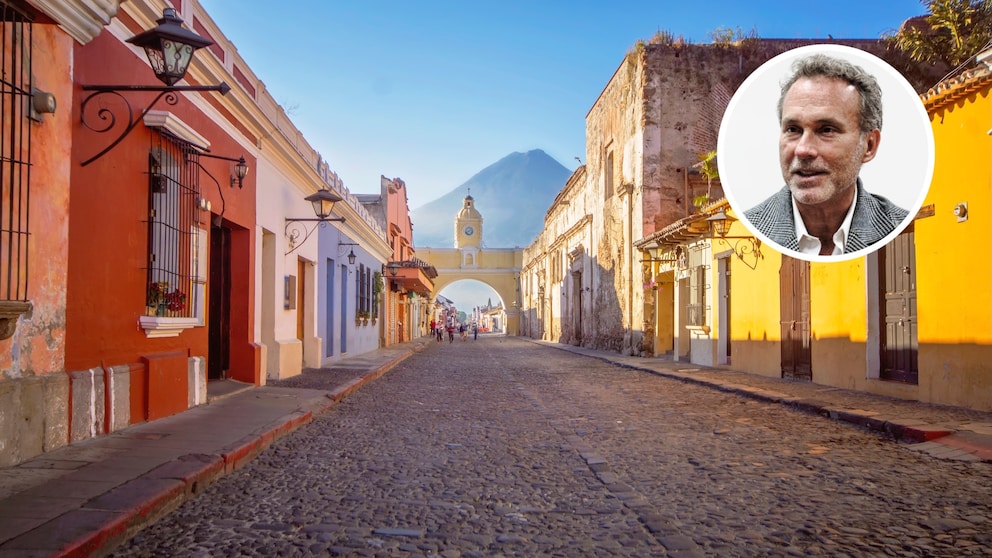
“From Guatemala City, you can drive to Antigua, the former Spanish colonial capital. You can easily spend a week there. Antigua is a UNESCO World Heritage site and has many excellent restaurants. Last year, the 50 Best Latin American Restaurants awards were held there, and they will be hosted there again this year. Antigua is also a good starting point for a volcano climb, such as on Acatenango. The ascent takes about seven hours. You stay overnight at the top and see the neighboring volcano erupt. The next day, you descend again.”
A famous attraction in Guatemala is also Lake Atitlán.
“This crater lake is one of the largest and deepest in the world. It was formed about 100,000 years ago by a volcanic explosion. Around the lake are 14 indigenous villages where different languages are spoken. You can travel from one village to the next and directly experience this cultural diversity. In the 1960s and 1970s, Lake Atitlán attracted many hippies. Cat Stevens lived in one of the villages at that time. This atmosphere has partly remained to this day. In San Marcos, for example, there is a pronounced New Age scene. But there are also very high-quality hotels. Many people from Guatemala City own weekend homes there.”
Guatemala has both a Caribbean and a Pacific coast.
“There are some of the best surf spots in the region. Small fishing villages are gradually developing into surfer towns with restaurants, nightlife, and small hotels.”
You already mentioned Antigua and that there are excellent restaurants there. What should one definitely try in Guatemala?
“I would first visit the Mercado Central in Guatemala City. There is an excellent food area. You can get tostadas, crispy tortillas with fresh guacamole and meat, for example. Guatemalan cuisine is very complex. Some stews contain 30 or 40 ingredients. Many recipes go directly back to traditions that are several centuries old. On the Caribbean coast, there is also a cuisine with a strong Afro-Caribbean influence and many spices. And even in modern gastronomy, Guatemala plays a role: 43 restaurants from the country were on the list of the 50 Best Latin American Restaurants last year. Guatemalan ingredients are reinterpreted there.”
“Reports of Kidnapped Tour Buses Full of Tourists Have Never Existed in Guatemala”
Many German tourists have safety concerns when it comes to traveling to Latin America. What is the situation in Guatemala?
“Many people worry when traveling from one place to another in the country. That’s why we often recommend domestic flights. A flight takes about 50 minutes, while the same route overland can take up to 14 hours due to the roads.”
And what about crime?
“As in many countries, safety mainly depends on common sense. The tourist regions are very safe. We recorded only about 70 tourism-related incidents in one year with 3.5 million visitors. Occasionally, a phone is stolen, but that happens everywhere. Reports of kidnapped tour buses full of tourists have never existed in Guatemala.”
Nevertheless, drug gangs are also active in Guatemala.
“Of course, there are problems in the country related to our geographical location. We are south of Mexico and are a transit country for smuggling and drug trafficking. But these activities are mainly concentrated in border regions or on sea routes.”
How many Germans are currently traveling to Guatemala?
“In 2025, we had almost 26,000 visitors from Germany. That was an increase of about three percent compared to the previous year.”
How do you plan to make Guatemala even more well-known as a travel destination in Germany?
“At the end of May, we are coming to the Berlin Design Week. There, we will showcase an installation: a five-meter-high depiction of the Great Jaguar Temple in Tikal made from 7 million small beads woven into a large pyramid. We are working with 17 young designers and traditional weavers. They present their work and tell their stories. We also produced a series currently running on Amazon Prime. It’s called ‘True Guatemala.’ There are six episodes, each about half an hour long, showing the country, its history, and traditions. I hosted them. I used to be a journalist.”
… and a very famous one. You reported for CNN from crisis and war zones around the world and were part of the reporter team that first reported the death of Saddam Hussein’s sons.
“In my heart, I am still a journalist. But at some point, I wanted to make a difference. Promoting tourism is a different form of communication for me. But ultimately, it’s still about telling stories.”