

October 23, 2026, 9:23 am | Read time: 6 minutes
Australia is almost as large as Europe. Each region functions like its own country. Things get pretty wild in the Northern Territory: nearly four times the size of Germany, but with only about 265,000 residents. People here live between ancient cultural traditions and adapting to harsh living conditions. Our author’s friend is currently backpacking there and tells TRAVELBOOK about her experiences among crocodiles, rodeo arenas, and bushfires.
If you want to travel from Sydney to the Northern Territory, you’ll spend about four and a half hours on a plane and land in Darwin. With around 120,000 residents, the capital is the only truly large city in the entire northern part of the vast continent. Incidentally, it’s closer to Bali from here than to Sydney.
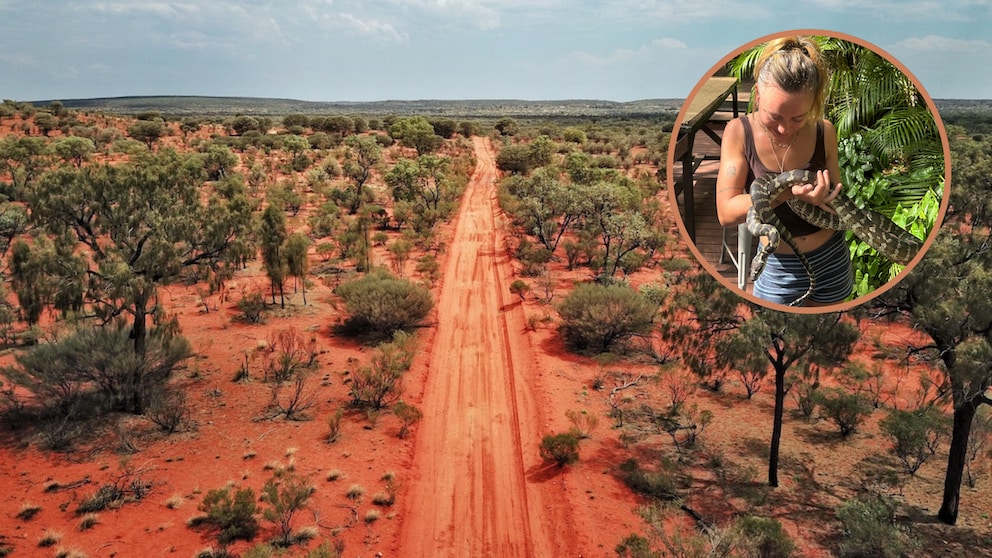
Most tourists use Darwin as a base for visiting waterfalls in Litchfield and Kakadu National Parks or for crocodile tours. If you want to see the Red Center, plan for a substantial road trip: It’s about 1,900 kilometers from Darwin to Uluru, roughly 20 hours by car. Outside the northern city, it quickly becomes desolate; this is the Outback. The “Aussies” (slang for Australians) also call it “back of beyond”–beyond the beyond. For hundreds of kilometers, there’s nothing but red sand, with a straight track running through it.
Eventually, a gas station appears by the roadside, often with a tavern next to it. Such roadhouses can be about 200 kilometers apart. Here, people from the vast surroundings meet, have a beer, and share stories from the road.
Baby Crocodiles Race Each Other
At such meeting points, the road sometimes offers more than just stories: Events are held here that attract everyone from the area. The most curious event my friend attended was a “Croc Race.”

The organizers bring baby crocodiles from nature parks or breeding farms, and they actually start the race. Each animal’s mouth is taped shut with colorful tape, each color representing a runner, and bets are placed on these colors. It’s not uncommon for $1,000 to be bet on a single crocodile, she says. Then the little ones waddle off between hay bales. Some get hopelessly lost, but one always reaches the finish line. After a few seconds, the racing fun is over, and whether the baby crocodiles find it as amusing is debatable. But the event is always a popular gathering spot.
Somewhat less dangerous but still curious: There are also frog races in the Northern Territory. The bright green, fist-sized frogs are given different colored chains, as bets are placed on everything here.
Bull Wrestling at the Rodeo
Almost more popular for betting and gatherings are the rodeos, which also regularly take place at taverns and gas stations. They’re quite rough, but still a classic family outing: Families arrive in huge trucks (almost everyone in the Outback drives a truck or Jeep), with camping chairs and coolers in tow. They secure a good spot early and turn the rodeo into a day trip. My friend says: Everyone wears cowboy hats and boots, even the little ones. Many men have cans of beer in hand, and she even discovered a German bratwurst stand.
Then the fun begins: Real cowboys compete in various age groups on wild bulls. Whoever stays on is celebrated; the longer they last, the louder the cheers. The best earn not only respect and applause but also a decent prize money. The cowgirls show their skills on horseback, and in some disciplines, they must lasso an animal. The steer wrestlers are particularly crazy: They jump from a galloping horse directly onto a young bull, grab it by the horns, and wrestle it to the ground–just like tackling in wrestling…

We find it questionable: The youngest fans are not only in the audience but also in the arena. She tells me about aspiring cowboys who compete at just eight years old and can sometimes get seriously injured. Or are we just too soft here?
Also interesting: 13 Things Travelers Should Avoid in Australia

Why Nepal is Both, a Nightmare and a Dream
My Spectacular Visit to the World’s Oldest Rainforest
Wild Nature and Attempts to Tame It
For European eyes, the handling of animals is generally something to get used to: bulls in the rodeo ring, baby crocodiles with taped mouths. In the Northern Territory, this is part of everyday life, as animals shape life here more than elsewhere.
This is especially true for crocodiles. They are bred on farms for meat and leather, which is used to make bags and shoes. There are even specialty stores that sell only crocodile products.

Wild crocodiles come very close to people. My friend spent a few weeks at a campsite in the Outback. On the grounds was a small lake, surrounded by only about a one-meter-high chain-link fence to keep the three huge crocodiles inside from escaping. When it rustled nearby at night, she knew: Ancient reptiles were moving around, capable of devouring her in one bite.
Just as unfamiliar to us are the kangaroos, hopping peacefully around. Some are small and cute, others mighty and muscular. “When one hops toward you with determination, you quickly get scared,” she says. The fear that they might hop onto the tent at night also gave her sleepless nights. Perhaps more paranoia than justified fear, as that, of course, never happened.
Her only real problems were with the huge toads. They were so large and sluggish that they simply wouldn’t get out of the way in the dark. Her solution: always swing a big stick in front of her to avoid stepping on them by accident.

Two Seasons–Two Worlds
Finally, something else sets the pace in the Northern Territory: the weather. In the Top End around Darwin, there are only two seasons, the dry season starting around May and the wet season starting around November. In between is the “build-up,” when it gets increasingly humid without rain.
During the dry season, almost nothing falls from the sky for months; in Darwin, in July, there’s an average of just one millimeter, according to the official tourism site. The grass withers, and bushfires are part of it. My friend says it’s quite normal and important for natural change. Only when smoke and flames come dangerously close to settlements or campsites is evacuation necessary. She experienced this herself.

Then the weather shifts: In January, Darwin receives over 430 millimeters on average, almost 400 times the total dry season. The parched landscape turns green, waterfalls thunder, and floodplains transform into lakes.
For people, this means staying flexible. Before the first week of the wet season, errands are done early in the morning; afterward, the rain closes some roads. Here, in the far north of the vast continent, everything works a bit differently.