

March 3, 2026, 1:24 pm | Read time: 4 minutes
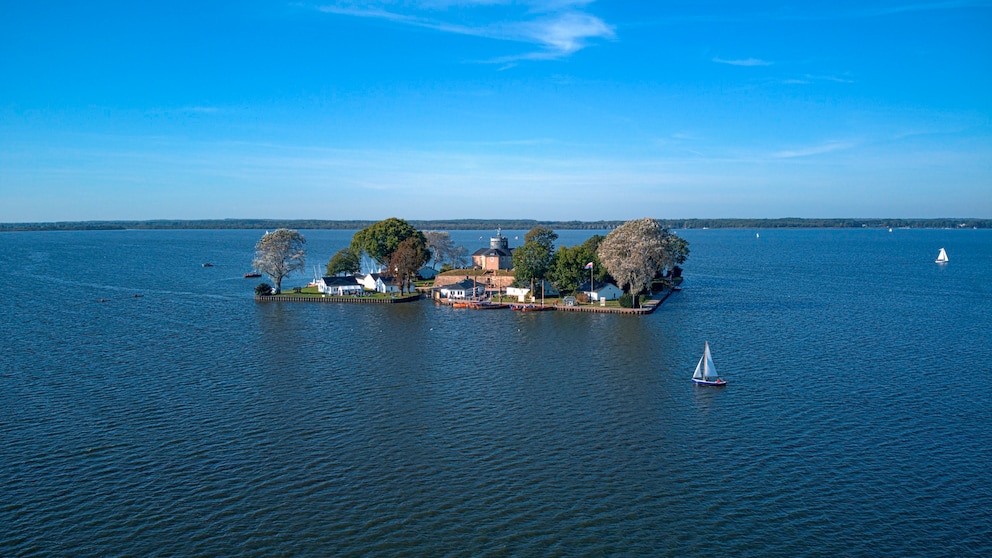
To protect his realm, Count Wilhelm of Schaumburg-Lippe built the Wilhelmstein Fortress in the middle of the vast Steinhuder Meer lake. Today, it is considered Germany’s smallest inhabited island—and it has a storied history.
The year is 1761 when Count Wilhelm of Schaumburg-Lippe rows out onto the Steinhuder Meer, Lower Saxony’s largest lake. Wilhelm fears for his realm, which is only 340 square kilometers, and for four years, an idea has been brewing in his mind. He wants to build a massive fortress in the middle of the Steinhuder Meer. On this day, Wilhelm personally throws a rock into the water, laying the foundation for his Wilhelmstein Fortress.
The fortress remains one of the main attractions of the Steinhuder Meer and, according to its official website, is also Germany’s smallest inhabited island. The 32-square-kilometer lake is surrounded by a total of 420 square kilometers of nature park. This is thanks to the tremendous effort under which the Wilhelmstein Fortress was once built, as described by author Pia Volk in her book “Germany’s Quirkiest Places: A Guide for Locals.”
A Fortress Emerges
Count Wilhelm has his loyal followers transport stones and building materials to the site where his Wilhelmstein Fortress is to stand for four years. From 1761 to 1765, entire teams row out onto the vast lake every day, loaded with up to 1,800 liters of stone on board. In all weather conditions, they pile up the foundation until it rises from the lake. The actual construction, which then takes another two years, begins.
By 1767, Wilhelmstein Fortress stands on a large main island surrounded by 16 additional artificial islets. They are later united into one island. Wilhelm opens a cadet school, which soon gains high esteem. The Wilhelmstein Fortress is manned by 250 men and 50 cannons, ready to defend Wilhelm’s realm in case of emergency. But the count is not satisfied with just that, and he becomes one of the most industrious inventors of his time.

Quirky Inventions
The count barricades himself in the fortress named after him and begins experimenting with gunpowder. In the end, he invents cannonballs filled with flammable liquid, equipped with barbs. In an emergency, they are supposed to get caught in the sails of enemy ships.
Additionally, the count invents a dagger that can also shoot, as well as a boat that can be divided into four parts. With the support of engineer Jakob Chrysostomus Praetorius, Wilhelm builds an amphibious vehicle that can move both on land and water. His masterpiece, however, for which he is still famous today, is the so-called “Steinhuder Pike”—nothing less than the world’s first submarine, as Volk writes.

16 Stunning Lakes in Germany–One in Each State!
These Beautiful Islands in Lake Maggiore You Can Visit
The World’s First Submarine
He already has the idea in 1760, but construction of a model only begins in 1771. His submarine is supposed to be about 30 meters long, with an interior height of just under two meters, just enough room to stand. The crew would enter and exit through hatches, and a kind of tail fin would steer the vehicle and provide propulsion. If the boat needed to surface, sails could be unfurled above water, according to Wilhelm’s idea.
Unfortunately, almost all records of the efforts at Wilhelmstein Fortress are lost today. However, Wilhelm’s submarine was probably never built to full size. According to a report that is also lost, a model submerged for twelve minutes during a test with eight men on board. Records from his successor suggest that a second submarine might have even been built.
Today, a Tourist Attraction
On September 10, 1777, Count Wilhelm of Schaumburg-Lippe dies, but his Wilhelmstein Fortress still stands in the Steinhuder Meer. According to the official website, it was abandoned as a station for soldiers in 1867. By the early 20th century, tourism was already thriving here. In normal times, visitors can reach the artificial island with its bastion in 30 minutes by boat.
Since 1900, people have been able to get married at Wilhelmstein Fortress, and there is now a hotel, a café, a souvenir shop, and a small beach. On guided tours, visitors learn all about Count Wilhelm and the island’s eventful history. And the “Steinhuder Pike” can also be admired, though unfortunately only as a small model and in sketches.