

March 27, 2026, 9:01 am | Read time: 6 minutes
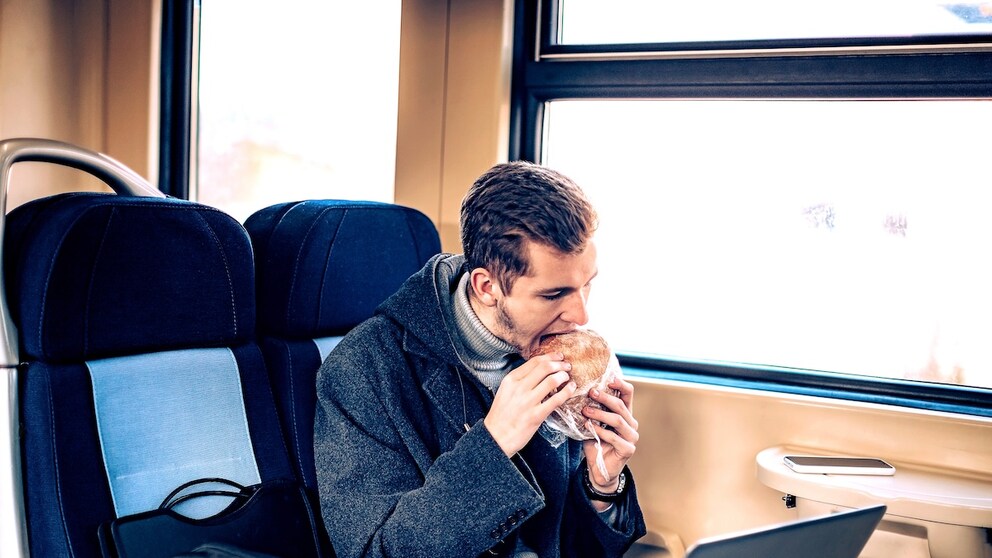
Train travel seems to have an appetite-stimulating effect on people. It’s common to see passengers on trains equipped with full meals and/or a variety of snacks, even on shorter trips. And often, other passengers in the car become aware of what’s being consumed. Yes, different foods have distinct smells. But which foods should perhaps not be eaten on the train? What should guide this decision? TRAVELBOOK explored this question and consulted etiquette experts for their insights.
Eating on the Train Is Naturally Allowed
Unlike in local transit, where eating is often unnecessary—and in some Asian countries, strictly prohibited—consuming food on long-distance trains is simply part of the experience for many. Hunger isn’t always the reason: Snacking passes the time and brings joy. But one person’s pleasure can quickly become another’s discomfort in this particular setting. A tuna sandwich or a fresh kebab (perhaps even with onions!) may be delicious, but the smells they emit can quickly become a nuisance for fellow passengers.
Smells naturally spread in a train, similar to diffusion, which we learned about in biology class: Particles move from areas of high concentration (right by the eater) to areas of lower concentration. Thus, the scents inevitably reach other passengers in the car, until everyone gets a whiff. Airing out the space? Unfortunately, with Deutsche Bahn, that’s often not possible: In modern trains, especially the ICE, windows can’t be opened for safety reasons.
What Smells Good and What Doesn’t Is Subjective
It’s important to note: Whether a smell is perceived as unpleasant is subjective. While one person might enjoy the smell of onion kebab, another might find it off-putting. It’s similar in a restaurant: At one table, truffle pasta is ordered with anticipation and enjoyed. Meanwhile, others find the earthy, garlicky smell, which becomes stronger after the serving lid is lifted, extremely unpleasant. But in a dining establishment, the “risk” of food odors is naturally part of the experience. On a train? Well, honestly, it is too.
Tastes vary—reaching a consensus on which foods smell appetizing or repulsive is unlikely. There are no official bans on specific foods in German long-distance travel. So how do you do it right? TRAVELBOOK consulted experts on this question.
Etiquette Experts on Eating on the Train
Linda Kaiser, vice chair of the German Etiquette Society, first points out that eating during the journey should ideally only be considered on long trips. And if it must be done, “then the food chosen for the train should be such that the smell doesn’t bother fellow passengers.” By “bother,” the expert means any noticeable food odors. Even seemingly pleasant-smelling foods like mandarins can be a torment for other passengers, according to Kaiser.
Since windows can’t be opened in modern trains, smells linger in the air for a long time, according to the etiquette expert. “Odorous food scraps and waste should therefore be packed airtight in a brought bag and disposed of.” And those who want to use the onboard kitchen should “preferably consume strongly smelling currywurst or chili con carne directly in the dining car rather than having it served at their seat,” she advises.
Not Just Smells Are a Nuisance for Fellow Travelers
TRAVELBOOK also spoke with Christian Heller, a business economist and licensed etiquette trainer. He emphasizes again that when eating on the train, it’s mainly about the “how.” Besides the top priority of avoiding smells, it’s also about respecting space. “Out of courtesy, one should avoid anything that quickly ‘takes up space,’ such as a large fast-food meal with lots of packaging,” says Heller.
To better understand which provisions on the train are more of a “no-go,” the expert mentions, in addition to strongly smelling foods—especially kebabs, other garlic dishes, and fish—very greasy or dripping meals. “Also, avoid loudly crunchy snacks, especially in quiet compartments.”

Is It OK to Take Off Your Shoes on a Plane?

Is It Okay to Recline Your Seat on an Airplane?
Consideration Trumps Rules
Heller refers to classic etiquette, as it traces back to Adolph Freiherr von Knigge. Accordingly, eating on the train is perfectly fine as long as one is considerate of others.
In reality, maintaining acceptable manners only requires common sense. After all, the train is a public space shared with others. And one certainly doesn’t want to sit at a dirty, food-stained spot. Therefore, according to Heller, it is essential to properly dispose of trash so that no packaging is left behind—the seat must be clean.
A True Provisions Classic Shouldn’t Really Be One…
A true evergreen among train provisions classics, surprisingly not yet mentioned here, is the hard-boiled egg. Anyone who has eaten one or witnessed its consumption knows the typical sulfur smell. This occurs as a normal chemical reaction: The sulfur compounds in the egg white react at about 100 degrees Celsius due to heat, releasing hydrogen sulfide.
Nevertheless, eggs are popular for their taste and are very healthy as a high-quality nutrient source—they provide protein as well as various vitamins and minerals like zinc and iron. No wonder they’re a popular snack. Interestingly, it’s now particularly easy for train travelers to stock up on eggs: At Berlin’s main train station, for example, you can now buy them individually and cooked at a bakery counter in an organic supermarket for a fairly low price of 80 cents each. Feel free to indulge—but keep your fellow passengers and the etiquette experts in mind. You can eat the eggs before boarding and dispose of the shells in one of the many trash bins afterward.