

February 20, 2026, 9:08 am | Read time: 4 minutes
Videos of trains with a special feature are currently causing amazed reactions on social networks. They show train seats that can be flipped with a few simple moves. This allows passengers to sit either forward or backward. Do you get sick from riding backward? Would you like to face your fellow passengers? No problem. What seems surprising to many has long been a part of everyday life in parts of Australia.
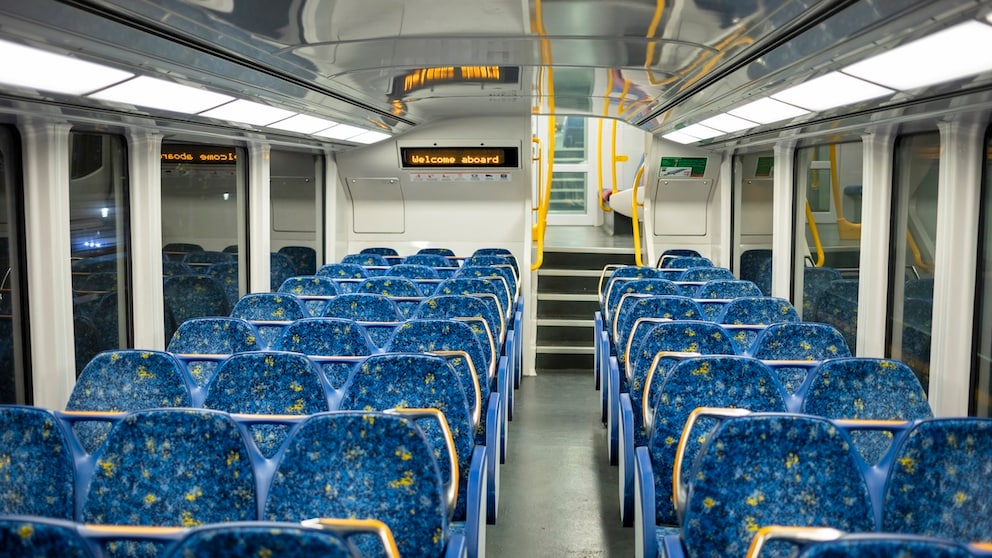
In Sydney, these so-called “Flip Seats” (“Millennium 4GT seats“) are standard in many suburban trains. Instead of being fixed in one direction, the seats have movable backrests. Depending on how you flip them, they create either a row of seats facing the direction of travel or a classic seating group with opposite seats. However, they are not found in all trains. Especially older and certain series in the greater Sydney area have the system. Newer models sometimes opt for fixed seats.
Simply Flip the Seats
The principle is simple: The backrest is folded forward and locks in on the other side. This allows the seating direction to be changed in seconds. If you don’t want to ride backward, just turn the seat around. Groups can arrange several seats to face each other, without having to search long for a free seating group. An advantage: If you’re traveling with family or friends, you can create a small seating group with just a few moves. At the same time, the capacity of the car remains flexible. Depending on the need, rows can be arranged behind each other or opposite each other.
Specifically, these seats are mainly found in the so-called Millennium trains (M-Sets). These have been operating in the Sydney Trains network since the early 2000s. These flip seats are primarily found in the so-called “Suburban Trains” around Sydney. These are trains that bring commuters from the suburbs to the city center. There, the directions of travel change regularly at terminal stations. With the movable backrests, the entire car can be quickly reoriented without passengers having to be moved. Comparable seating systems were or are also installed in some intercity trains in the state of New South Wales.
8 Tricks You Can Use to Almost Always Fly Next to an Empty Seat

Are you familiar with the WILMA principle?
Why Train Seats Are Going Viral Online
On social media, users show how flexibly the seating rows can be adjusted. With a few simple moves, a row of seats becomes a group of four or six, and a backward seat becomes a forward-facing one. The videos reach millions of views, with many commenting in surprise or disbelief. Travelers from Europe, in particular, react with astonishment because comparable systems are not widespread there. In Germany, for example, seats in trains are usually fixed, so some passengers inevitably sit against the direction of travel.

The fact that entire seating groups in Australian trains can be spontaneously reoriented seems like a small revolution in the daily commute for many, even though the principle has existed there for years. The viral videos show one thing above all: Sometimes it doesn’t take a high-tech innovation to excite people–just a practical solution for everyday life. And that’s exactly what the Australian train seats seem to deliver.
Not a New Concept–but New to Many
The idea is not entirely new. Similar systems also exist in Japan: On many Shinkansen trains, the seats are rotated 180 degrees at terminal stations so that they face the direction of travel again. Depending on the train type, passengers can also rotate the seats themselves, for example, to form a group of four or six.
What might surprise many: Even in Germany, the principle is not entirely unknown. According to “Passauer Eisenbahnfreunde e.V.,” the Uerdingen railbuses (VT 98) of the Deutsche Bundesbahn in the 1950s and 1960s already had flip-back backrests. Passengers could adjust the seating direction as needed back then—a detail that has disappeared in regular operations today.