

October 30, 2026, 9:47 am | Read time: 4 minutes
When traveling by train in China, you can not only bring your own food, rely on the onboard restaurant, or small snack carts, but also have food delivered from the station to your seat at the next stop. We explain how easy it is.
High-speed trains in China transport millions of people daily between major cities and into more rural areas. During peak times, up to 16 million passengers use the system each day. The fastest trains travel up to 350 km/h, with tickets available for as little as about 10 euros, depending on the route. For Shanghai–Hangzhou in second class, for example, you pay around 73 yuan (about 9.80 euros).
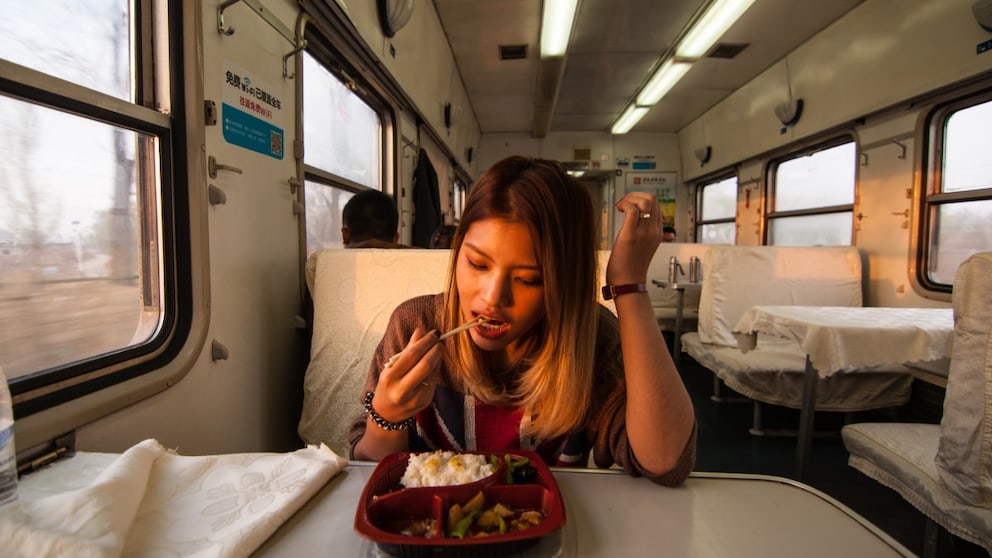
For those who don’t want to go hungry on trips that can last nearly eight hours, there are several options. The classic choice: homemade lunch boxes. Locals often opt for snacks from convenience stores. Instant noodles are also popular–hot water is usually available at the end of the car.
A Real Alternative to the Onboard Bistro
If you’re craving something warm or forgot your box, you can head to the central dining car, similar to the bistro car on Deutsche Bahn’s ICE trains. However, due to strict safety measures, cooking with open flames or gas is not allowed on the trains, so mainly pre-cooked rice boxes with meat and vegetables are available, which are heated on site. Prices on board vary depending on quality and menu. Reddit users, however, report sometimes high prices of up to 10 euros for relatively bland ready meals.
There has long been a real alternative that might surprise you: the Chinese railway’s ordering infrastructure. The ordering service started in July 2017 at 27 major stations nationwide. Initially, you had to order up to two hours before arrival. Since early 2018, one hour is sufficient. According to Chinese sources, there are now about 90 stations.
Ordering Food from a Moving Train
You can order food online from a restaurant or fast-food stand at any upcoming stop and have it delivered to your seat without moving.
Simply scan the QR code on the armrest or tray table with Alipay or WeChat. You’ll need both apps during a stay in China anyway. A window opens showing the train’s route. Click on the station from which you want to order. If the code is missing from the seat, the official “12306” app of the Chinese railway can help. Tap on Food & Specialties and enter the train number.
Click on the international symbol for food, fork and knife (even though only chopsticks are traditionally available on the trains), and a list of all restaurants at the selected station opens. These are usually local snack stands or international fast-food chains. You can digitally order anything offered. Finally, enter your car and seat number and pay.
When the train stops at the chosen station, do not get off to pick up the food. Stops often last only about two minutes. The train attendants are prepared: A courier brings the food to the platform and hands it to the train staff. They then distribute it to the assigned seats, and it should arrive warm within 10 minutes. Delivery is usually free or costs a maximum of 8 yuan, about one euro.
Foreigners should test payment beforehand: Some forms require a Chinese phone number, and foreign cards don’t always work.

Recipe for Delicious Mapo Tofu from China

9 Tricks to Find a Seat on the Train Without a Reservation
In These Trains, Food Can Be Ordered from Outside
The letters on the ticket are crucial. G-trains are the fastest, traveling at 300 to 350 km/h. D-trains are slightly slower, sometimes operating as night trains. C-trains shuttle between nearby cities. Food can only be ordered on G-, D-, and C-trains, not on the classic slow trains.
Could the Concept Work in Germany?
The travel blogger who made the concept somewhat known through social media titled her video on the step-by-step ordering process “Deutsche Bahn could never.”

The disappointment over delayed trains, crowded cars, closed bistros, and so on is deeply ingrained in many German train travelers. A networked ordering system like in China would require significant effort and cost to develop, not to mention implementation during short stops and staffing. So, in Germany, we’ll likely have to continue bringing our lunch boxes on the train–but please, no eggs, salami, or onions!