

November 16, 2022, 10:09 am | Read time: 5 minutes
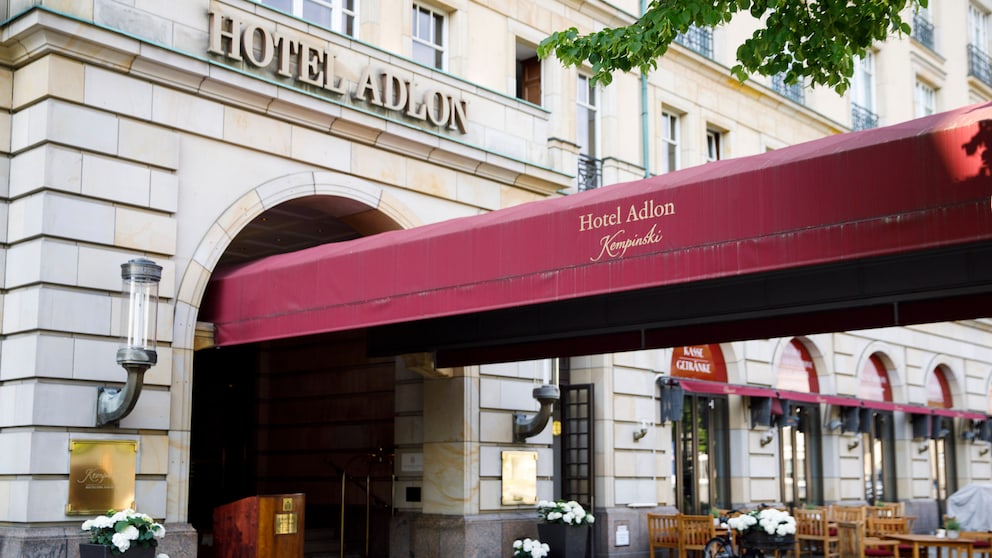
Since October 2022, the luxury hotel Adlon Kempinski Berlin is being led by a woman for the first time in its history: Karina Ansos. She previously worked in other hotels of the Kempinski group, including in Weimar, Shanghai, and Frankfurt, and now takes over one of Germany’s most famous establishments with the Adlon. But what history lies behind this grand hotel name?
The famous Hotel Adlon in Berlin is known to almost everyone: Located directly at Pariser Platz with a view of the Brandenburg Gate, the hotel not only overlooks Berlin’s most famous historical landmark but also boasts a history of more than a hundred years. For the first time in that history, it is now led by a woman, Karina Ansos. What a historic hotel Ansos now leads–TRAVELBOOK provides an overview.
The Early Years
According to the hotel’s website, the building’s history as a hotel begins in 1905. At that time, hotelier Lorenz Adlon purchased the property and transformed it over a two-year construction period into a neoclassical building intended primarily as accommodation and a venue for the nobility and the wealthy. The construction was personally supported by Kaiser Wilhelm II. In previous centuries, hotels served merely as overnight accommodations–the concept of luxury hotels with restaurants and event spaces was still quite new and had previously gained traction in major cities in the U.S., as well as in Paris and Vienna.
The rooms at the Adlon were luxuriously equipped, all featuring electricity and warm running water. Before World War I, high-ranking nobility such as the Russian Tsar, emperors, and kings frequented the hotel, as did politicians and entrepreneurs, as reported by “Spiegel.”
After the war ended, the Adlon experienced its Golden Twenties. Personalities like Marlene Dietrich and Charlie Chaplin were guests at the hotel. Business with Americans particularly boomed, bringing the hotel international fame. In 1921, Louis Adlon inherited the hotel from his father, who had been run over at the Brandenburg Gate and died from the accident’s consequences. Louis Adlon soon divorced his first wife, Tilly, and married Hedda, with whom he then managed the hotel.
Also interesting: 8 Celebrity Hotspots in Berlin

This Massive Underground Nazi City Is Now a Tourist Attraction
The Exciting History of the Monastery Kloster Lehnin
The Hotel During Wartime
After Adolf Hitler’s rise to power, part of the building was briefly used as the Foreign Office of the NSDAP. During the Nazi era and the war, the hotel saw a decline in international guests. Louis and his wife Hedda later joined the NSDAP, according to “Spiegel,” though it is disputed whether they were truly Nazis. Their relatively late party membership in February 1940 is cited as evidence. Nevertheless, the Adlon remained connected to the Nazis. From 1943, it became a venue for events of the Nazi elite after the previously preferred hotel, the Kaiserhof on Wilhelmstrasse, was destroyed in bombings.
The Adlon itself initially remained miraculously unscathed by bombings during World War II. However, this luck was short-lived, as the hotel was almost completely destroyed by fire on the night of May 2-3, 1945, as reported by “WELT.” Near the war’s end, another dramatic event occurred in the Adlon family: On April 25, 1945, Louis Adlon was arrested by Soviet soldiers after a search of his house in Neu Fahrland. He died under not fully known circumstances in their custody on a street in Falkensee on May 7, 1945, as noted in the local state archive.
Was the Adlon Unjustly Expropriated?
The fire and the death of Louis Adlon marked the temporary end of the world-famous hotel. It wasn’t until the early 1950s that the remaining walls of the Adlon were cleared. In 1949, the Adlon family was also expropriated. As BILD reports after an interview with heir Felix Adlon, the hotel property was placed on “List 3″–a law for the “confiscation of assets of war criminals and Nazis.” Felix Adlon initially took legal action against this, in his view, unjust expropriation in December 2022. The Berlin Administrative Court initially dismissed the claim for compensation in the millions, but the heir now plans to take the case to the Federal Constitutional Court. Whether the lawsuit will be successful there is unclear.
However, the further historical course of the Adlon is clear. Under state ownership, the undamaged side wing of the building was initially continued to be used as a hotel and restaurant and subsequently as an apprentice dormitory until its demolition in 1984.

Also interesting:I stayed in a luxury hotel for the first time–and wouldn’t do it again
The Reconstruction of the Adlon
The foundation for the reopening of the Adlon was laid as early as 1957 when Hedda Adlon sold the rights to the name “Hotel Adlon” to Kempinski AG. After German reunification, the hotel was rebuilt according to plans by the architects “Patzschke, Klotz & Partner,” financed by Fundus-Fonds-Verwaltungen GmbH, as stated on the hotel’s website. From 1995 to 1997, the building was reconstructed in the style known today, but with two more floors than the “old” Adlon. Kempinski received the lease for the Adlon Hotel. On October 23, 1997, it was officially inaugurated by Federal President Roman Herzog.
Since then, it has served as a luxury hotel under the name Adlon Kempinski, as before. Today, after two extensions in 2003 and 2004, it features 307 rooms, 78 suites, 2 restaurants, a spa area, event spaces, and even two ballrooms, according to the hotel website. Today, as more than 100 years ago, it hosts all who can afford the rooms in the luxury hotel–celebrities, politicians, U.S. presidents, and members of European royal families. Prices start at just under 400 euros per night for the cheapest room category and go up to 16,344 euros for the Royal Suite, where Queen Elizabeth II and Michael Jackson have stayed (prices vary depending on the season).