

September 21, 2026, 8:13 am | Read time: 6 minutes
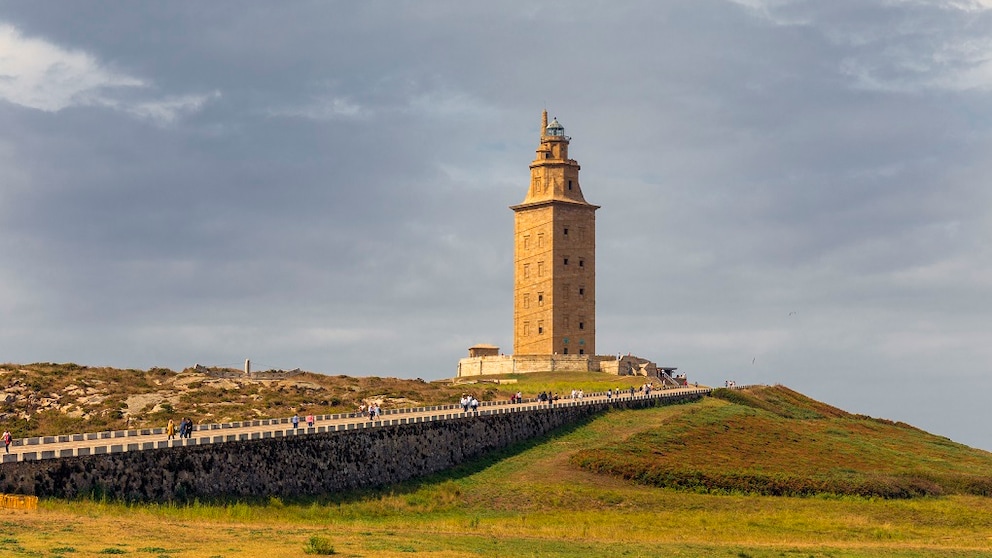
In the Spanish city of A Coruña in Galicia stands the Torre de Hércules, the oldest lighthouse in the world. Likely built by the Romans as early as the second century AD, it still serves its purpose today. It’s no wonder that numerous legends surround this UNESCO World Heritage site, and these tales are not limited to Spain.
For nearly 2,000 years, a remarkable monument has stood on a prominent point above the sea near the Spanish city of A Coruña in Galicia. Rising 55 meters into the sky, it has likely saved thousands of lives over its existence. This is the imposing Torre de Hércules lighthouse. Probably constructed in the second century AD under Roman Emperor Trajan, it remains operational today, making it the oldest lighthouse in the world. TRAVELBOOK tells its astonishing story and reports on the many legends surrounding the beacon.
According to the official tourist website “Visitar Galicia”, the history of the Torre de Hércules, or the Tower of Hercules, begins at the turn of the first to the second century. The exact year construction began on this navigational point for sailors is unknown today. However, some other details are known. For instance, the name of its architect is known. It was a Portuguese named Gaio Sevio Lupo from Coimbra, who engraved his name into the building’s stone. At that time, A Coruña was a Roman settlement called Brigantium, and due to its location between the Atlantic and the Mediterranean, it was an important trading post. If it weren’t for the countless shipwrecks that repeatedly occurred off the coast.
From Lighthouse to Defense Facility
To prevent or at least limit these in the future, the Torre de Hércules was built. Even then, it measured about 50 meters in height, a remarkable architectural feat for that time. After its commissioning, ship traffic in the region rapidly increased, making A Coruña/Brigantium one of the most important port areas of the entire era. At that time, the lighthouse was operated with fire. With the fall of the Roman Empire, which concluded in the fifth century, the history of the Tower of Hercules seemed to come to a premature end. Yet, it still guides ships safely through the region’s waters today.
Also interesting: The eerie legend of the Mouse Tower of Bingen
According to the official tourist website of Galicia, after the end of Roman rule, the Torre de Hércules initially fell into decline. Germanic tribes increasingly invaded the area, ship traffic eventually ceased, and the lighthouse lost its significance. However, it likely still served as a navigational point for Germanic sailors during this time. When the Normans repeatedly invaded the region from the 9th century onward, the building was eventually converted into a defense facility. Archaeological finds indicate that it must have also contained a kitchen. In the 13th century, the tower was temporarily abandoned with the founding of the city of Crunia, now A Coruña.
The Creepy Legend of the Mäuseturm in Bingen
How did the coasts in Spain actually get their names?
Demolition and Reconstruction
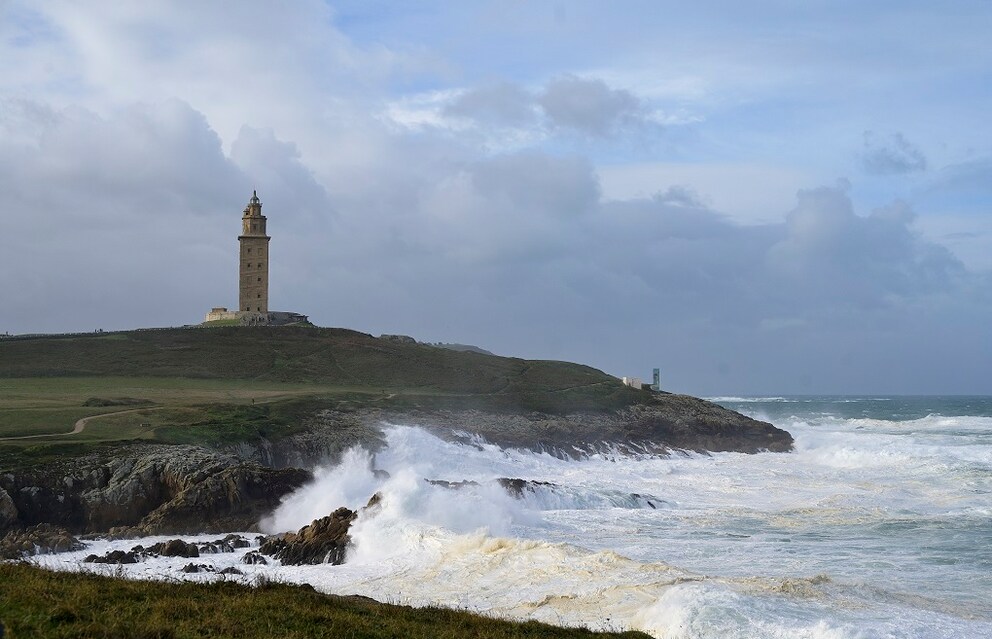
Subsequently, it even served as a quarry for a time, as its high-quality material was in demand for building fortifications. In the 16th century, the Torre de Hércules was known as the “Old Castle” and continued to be used as a lookout post to warn of dangers from the sea. The tower guards were paid by the city. In 1553, the city council banned further stone extraction for construction purposes, and in the 17th century, the Tower of Hercules regained its function as a lighthouse. From 1684, it was extensively restored, and its technology was continuously improved over the following years and centuries.
Also interesting: Tower of London – England’s mighty super fortress
In 1788, renovation work on the Torre de Hércules began on the orders of King Charles III, as it still appears to viewers today. The measures under military engineer Eustaquio Giannini were completed in 1790. Between 1799 and 1806, it received a rotating beacon with an oil lamp for the first time. However, this was replaced in 1927 when the lighthouse was electrified. Since 2009, it has been officially recognized as a UNESCO World Heritage site and is generally one of the most popular tourist attractions in all of Galicia. Today, it is considered the oldest lighthouse still in operation worldwide. The city of A Coruña features it as a symbol in its coat of arms.
Legends Surrounding the Monument
It’s not surprising that numerous legends surround such an epochal monument. For example, the story of how the Torre de Hércules got its name. According to the official website of the city, the mythical hero Hercules once fought the evil giant Geryon here, who terrorized the land. He finally defeated him in a three-day battle, beheaded him, and buried his enemy by the sea. As a sign of his triumph, he erected a lighthouse on the same spot. He then founded the city of Crunia, named after the first woman who is said to have settled there and with whom he was in love.
Another tale about the tower takes us to Ireland and tells of the Celtic hero Breogán. According to this legend, he once conquered the region and then built the Torre de Hércules, which he named the Breogán Tower after himself. It was his son who first saw Ireland from the top of the tower after his death and immediately set out to conquer it. However, it was only his son who finally succeeded in taking the Green Isle. The spread of this legend was promoted in the 17th century by the Irish-Catholic colleges founded in Spain. On the official website of A Coruña, these and other legends about the tower can be read.
Also interesting: Tower of Silence – the world’s most bizarre cemetery
Anyone who wants to visit the Torre de Hércules can do so year-round. The regular admission price is three euros, reduced to 1.50 euros. However, the tower is closed in strong winds.