

November 19, 2025, 6:22 pm | Read time: 9 minutes
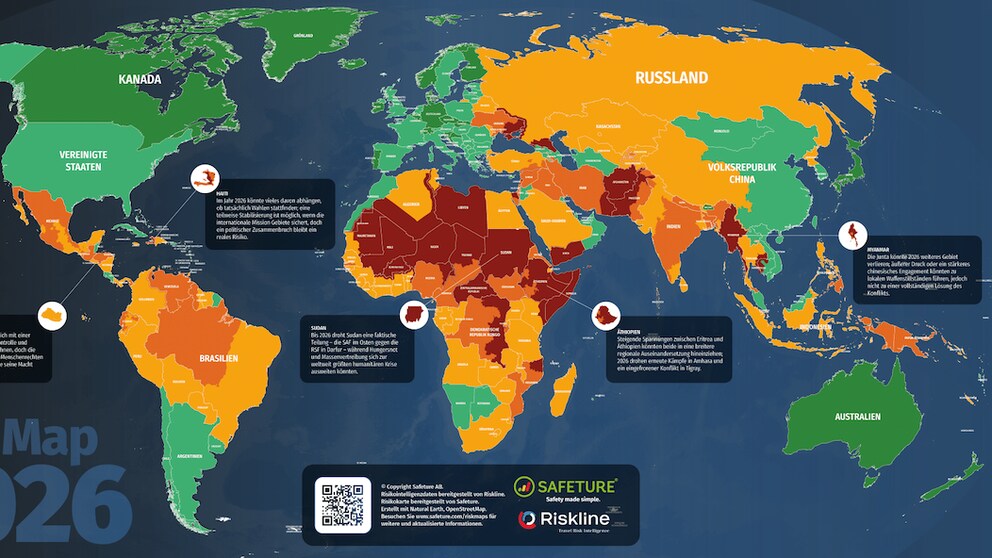
The security experts from the companies Safeture and Riskline have released their latest Risk Map. It highlights the safest and most dangerous countries in the world, as well as cities travelers should avoid in the coming year. TRAVELBOOK presents the findings.
How safe is the world these days? Where can you travel with peace of mind, where should you be cautious, and which countries and cities should you avoid for now? The topic of safety continues to polarize, especially given the situation in the Middle East, the Russian war of aggression in Ukraine (TRAVELBOOK reported), the disastrous conditions in Sudan, and numerous other global crisis hotspots. Added to this are the sometimes devastating effects of climate change and security concerns such as domestic political situations, crime, and more.
To provide travelers (and everyone else) with an overview of the global situation, the Institute for Economics and Peace, for example, examines the state of peace and security worldwide each year in its Global Peace Index (TRAVELBOOK reported). Various companies also regularly release new Risk Maps, such as International SOS and A3M Global Monitoring GmbH.
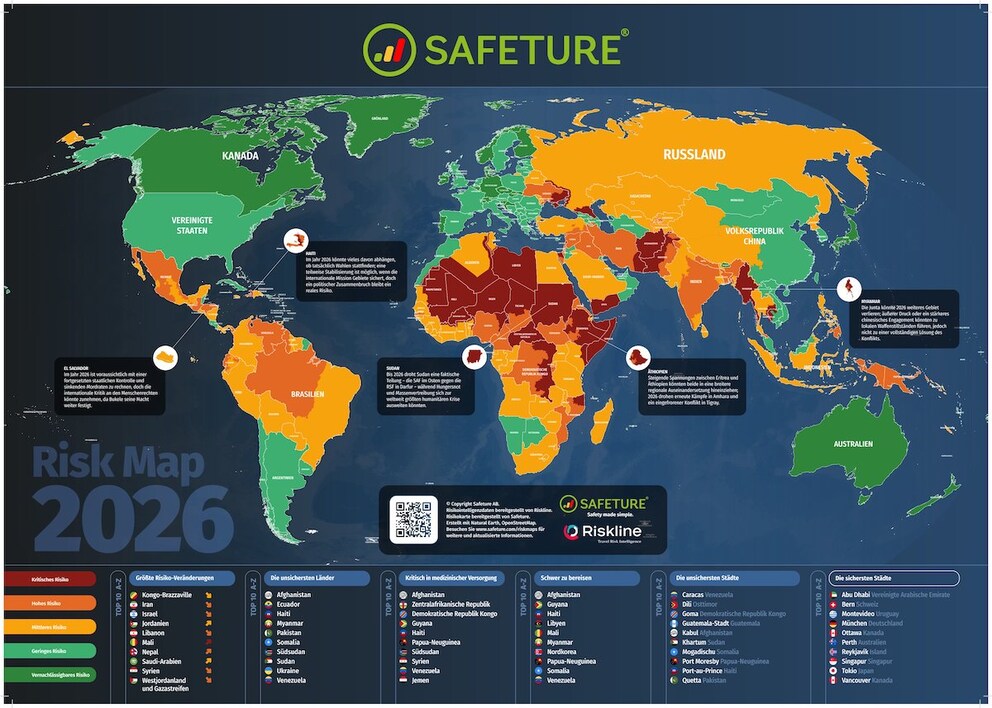
Similarly, the partnered companies Safeture and Riskline release an annual risk map. This Risk Map 2026 not only shows the situation in individual countries but also highlights which cities are currently particularly safe or unsafe, where health risks are high, and which countries have recently undergone significant changes in their security status.
Overview
The Risk Map
The Swedish software company Safeture, which claims to offer a “platform for professional risk management for travel safety,” developed the global risk map. This was based on data from the Danish company Riskline, which specializes in analyzing global travel risks. The map itself is divided into five color gradations: dark green (negligible risk), light green (low risk), yellow (medium risk), orange (high risk), and red (critical risk). To determine a country’s risk level, factors such as security, crime, health and environmental risks, and local medical care are considered.
Which data these are, where they come from, and how exactly the safest and most dangerous cities and countries are determined is not detailed in Safeture’s statement. It is only mentioned that more than 100,000 data sources are processed by AI-supported professional analysts at Riskline. Last year, Riskline’s homepage provided a bit more information: “We use proprietary technology that continuously monitors Open Source Intelligence (OSINT) for travel.” According to this, analysts verify and validate information daily from sources such as local and social media, government advisories, law enforcement, emergency services, security forces, and disaster relief.
Inquired at Riskline
How exactly the lists of the safest and most dangerous countries and cities were created remains questionable. TRAVELBOOK inquired with Riskline and Safeture. Nikita Billier, Security and Political Risk Analyst at Riskline, explains: “When creating the security assessment for a specific country, we apply a structured risk level methodology based on internationally recognized risk management practices.” Each report evaluates five risk levels from low to extreme, reflecting both potential and actual impacts of a threat, as well as the likelihood of it occurring. Considered are “the consequences for travel, personal safety, and to a lesser extent, assets.” The likelihood of an event is assessed based on how likely or unlikely it is to occur. Billier says: “The final risk level results from the intersection of impact and likelihood (…).” This methodology is applied in the country reports across several areas, including politics, conflicts, terrorism, unrest, crime, natural hazards, health risks, and local travel conditions.
TRAVELBOOK’s inquiries to Safeture remained unanswered by the editorial deadline.
The Global Situation
“The world has unfortunately not become safer,” says Marcel Brandt, Chief Sales Officer of Safeture, in a statement on the Risk Map 2026. On the contrary, new travel risks are emerging in many places, and danger situations are changing rapidly. According to Safeture, “armed conflicts remain the main reason for travel risks.” In addition to combat operations, it is often civil unrest, high crime rates, weak governments, and border conflicts that characterize the most dangerous countries in the world. These still include Afghanistan, Myanmar, and Pakistan, as well as Ukraine, which remains at war with Russia, and other African, South, and Central American states.
The 10 Most Dangerous Countries in the World*
- Afghanistan
- Ecuador
- Haiti
- Myanmar
- Pakistan
- Somalia
- South Sudan
- Sudan
- Ukraine
- Venezuela
*According to Safeture, the order of the countries is not a ranking but an alphabetically ordered overview.
How quickly the situation can change is shown by the list of countries where the partnered companies have identified the greatest risk changes. According to Safeture, the “classification of Israel, Lebanon, Iran, as well as the West Bank and Gaza Strip” fluctuates due to the Gaza war. According to Riskline, the war initially reached an “extreme peak” in June, but since the ceasefires, the situation has improved to at least a “high risk.”
In Martinique, the companies identified a medium risk during the protests, after which the situation stabilized. Improvements were also noted in New Caledonia after the unrest ended. Conversely, the risk on the Turks and Caicos Islands has increased due to crime. In Mali, Nepal, and Mozambique, the risk has risen due to jihadist attacks, Generation Z protests, and post-election unrest, while the situation in Congo-Brazzaville and Bangladesh has stabilized.
Health Risks and Difficult to Travel
In addition to the general danger situation and the greatest risk changes, the Risk Map also categorizes “Critical in Medical Care” and “Difficult to Travel.” According to Safeture, health systems in many high-risk countries remain fragile, citing Afghanistan as an example. The country is “attributed a very high medical risk due to a lack of basic infrastructure and limited international support.” The company also sees significant health risks in Papua New Guinea, the Central African Republic, South Sudan, Syria, Yemen, Haiti, Venezuela, Guyana, and the Democratic Republic of the Congo. Preventable diseases break out there, and there is a lack of medical supplies and access to medical care.
Afghanistan also appears on the list of difficult-to-travel countries, along with several others already mentioned here. According to Safeture, traveling to Afghanistan poses “significant dangers,” as militant groups and terrorists often target public areas and transportation infrastructure. The company advises women and LGBTQ+ travelers to avoid the country, as both groups are particularly at risk due to the Taliban’s strict and discriminatory laws. Travel is also very difficult in North Korea and Myanmar, where strict political control mechanisms, internal conflicts, and scarce public services complicate travel. Riskline describes travel to these countries as “unpredictable.” Also on the list are Papua New Guinea, Libya, Somalia, Haiti, Venezuela, and Guyana. Safeture cites “crime, poor transportation infrastructure, and limited flight connections” as reasons.
These Countries Are Considered Safe
Amid all the world’s horrors, it’s important to remember that there are many destinations where travelers can visit without worry. A look at the Risk Map 2026 shows some dark green spots, indicating countries where the risk is “negligible.” These are (alphabetically ordered):
- Australia
- Belgium
- Bhutan
- Denmark
- Germany
- Finland
- Greenland
- Ireland
- Iceland
- Japan
- Canada
- Croatia
- Luxembourg
- New Zealand
- Norway
- Portugal
- Switzerland
- Slovakia
- Slovenia
- Czech Republic
Additionally, there are various light green countries, indicating those with a low risk.
Comparing the listed countries with those on other risk assessment world maps and reports, many overlaps are likely to be noticed. For example, Iceland consistently ranks first in the annual Global Peace Index, and Ireland, New Zealand, and Switzerland generally rank high as well. Many of the names mentioned here were already on last year’s Risk Map from Safeture and Riskline. Switzerland was not only considered generally safe, but the Swiss city of Bern was also listed as the safest worldwide in 2025.
The Most Dangerous (and Safest) Countries in 2025
Countries to Avoid Traveling to in 2026
The (Un)Safest Cities in the World
In addition to the various safe and unsafe countries, Safeture and Riskline have also identified the safest and most dangerous cities in the world. Some names on these lists may be familiar from last year, while others are new. One of them is German: Munich is among the safest cities for the coming year.
The 10 Safest Cities 2026*
- Abu Dhabi, United Arab Emirates (not listed in 2025)
- Bern, Switzerland (also in 2025)
- Montevideo, Uruguay (not listed in 2025)
- Munich, Germany (not listed in 2025)
- Ottawa, Canada (also in 2025)
- Perth, Australia (not listed in 2025)
- Reykjavík, Iceland (not listed in 2025)
- Singapore, Singapore (also in 2025)
- Tokyo, Japan (also in 2025)
- Vancouver, Canada (not listed in 2025)
* According to the Risk Map 2026 by Safeture and Riskline
The safest cities in the world, according to Safeture, have low crime rates, effective police work, and stable government leadership. In contrast, the most dangerous cities worldwide experience combat operations and unrest. They also often struggle with organized crime.
The 10 Most Dangerous Cities 2026*
- Caracas, Venezuela (not listed in 2025)
- Dili, East Timor (not listed in 2025)
- Goma, Democratic Republic of the Congo (not listed in 2025)
- Guatemala City, Guatemala (not listed in 2025)
- Kabul, Afghanistan (not listed in 2025)
- Khartoum, Sudan (also in 2025)
- Mogadishu, Somalia (also in 2025)
- Port Moresby, Papua New Guinea (also in 2025)
- Port-au-Prince, Haiti (also in 2025)
- Quetta, Pakistan (not listed in 2025)
* According to the Risk Map 2026 by Safeture and Riskline
According to Riskline, the cities reflect national trends. For example, Beirut, Damascus, Tehran, Tel Aviv, and Jerusalem have all seen an “increase” in risk amid ongoing conflicts. Similarly, the risk situation in Jakarta and Kathmandu has worsened “due to youth-led protests.” In Myanmar’s capital Naypyidaw, the danger level has risen to an “extreme value” following militia attacks and natural disasters. In Acapulco and Los Cabos, the risk has increased due to cartel violence, while the situation in Seoul rose to a moderate risk during protests, as Riskline writes. Conversely, Dhaka has stabilized.
Outlook
The outlook for the future appears rather bleak at Riskline. The company is convinced that the “global risk landscape” will remain “dynamic” given the changing political tensions, evolving conflict zones, and climate pressures. All these factors are interconnected and not only affect security but also make “travel risks harder to predict,” according to Riskline. Accordingly, real-time information, as well as good planning and flexibility in risk management, are important for businesses and people traveling for work. It also helps vacationers to stay well-informed and have an emergency plan in place when traveling to countries not considered safe.