

December 19, 2024, 1:11 pm | Read time: 7 minutes
Political unrest, the threat of terrorist attacks, war, natural disasters, and a high crime rate pose significant safety risks not only for locals but also for travelers. Additionally, dangerous infectious diseases and poor medical care can have fatal consequences, especially when combined. The interactive world map “Risk Map” shows which parts of the world you need to be particularly cautious in 2025.
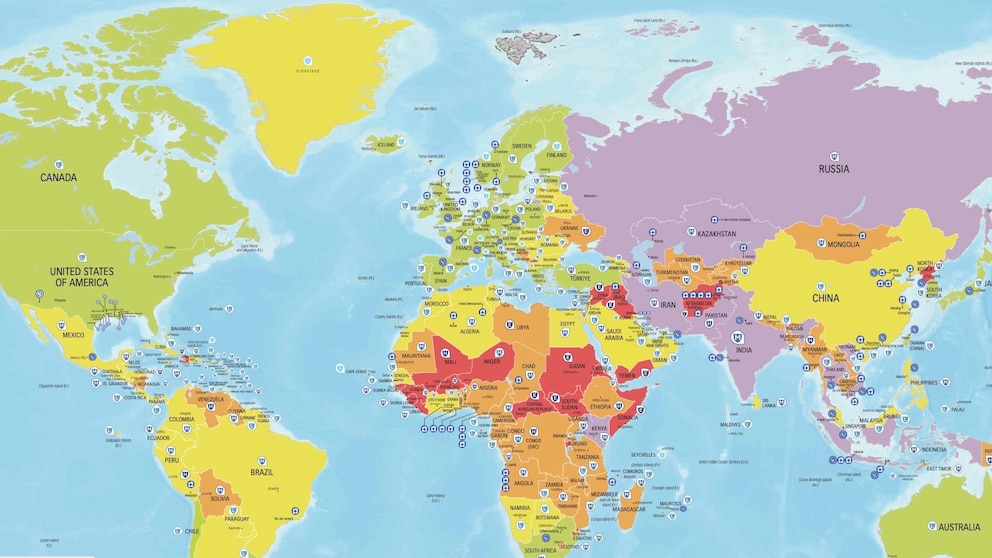
Anyone traveling naturally wants to be informed about the safety situation in their vacation destination beforehand. The “Risk Map” by the company “International SOS” shows which countries are the most dangerous and where the risks for travelers worldwide are particularly high. „Risk Map“ des Unternehmens „International SOS“.
Overview
How the Data Is Collected
The data for the interactive “Risk Map” is compiled from analyses of 2024 and forecasts for the coming year. This allows the current global situation to be assessed based on four different criteria. In addition to general safety, medical risk, mental health, and the impacts of climate change are considered. The results are divided into five risk levels: negligible (green), low (yellow), medium (orange), high (light red), and extreme (dark red). The assessments are primarily aimed at businesspeople and companies, but the world map also serves as a guide for travelers.
Where the Safety Risk Has Changed
In the countries of Sudan, Lebanon, Israel, Iraq, and Myanmar, risk assessments have been repeatedly reviewed. Violent conflicts on the ground have led to an increase in the risk level to “high” or even “extremely high.” The risk in New Caledonia also increased from “low” to “medium” last year. This is due to the effects of social unrest and economic decline, which have led to a rise in crime. Rising crime and social unrest have also caused negative changes in parts of South Africa, Mexico, and Kenya.
Changes have also occurred in the area of medical risk in some countries, leading to a shift in safety risk. For example, the risk in Bolivia is now classified as “high” instead of “medium.” Libya, on the other hand, has seen positive changes and is rated better this year than last. While “International SOS” assessed Libya’s safety risk as “extremely high” in 2024, the verdict for 2025 is now only “high.” These changes are due to shifts in medical risks, influenced by factors such as access to health facilities, availability of medications, and disease prevention.
Which Countries Are Particularly Safe?
According to “International SOS,” various factors such as the threat of terrorism, war, unrest, assaults, kidnappings, and fraud play a role in assessing safety risk. The risk of natural disasters and the condition of transportation infrastructure can also be included in the evaluation, especially if their risk level is high enough to have noticeable consequences.
According to the “Risk Map,” the safety risk is considered negligible in countries such as Andorra, Denmark, Finland, Greenland, Iceland, Liechtenstein, Luxembourg, Norway, Switzerland, and Slovenia.
BILD Travel: Discover the best hotels in Andorra now!
According to International SOS, the crime rate, as well as political, sectarian, and racial violence, is very low in these countries. Additionally, security and rescue services are rated as very effective, and the infrastructure is considered absolutely solid. Only ten countries have managed to perform equally well in all these criteria.
The 10 Safest Countries Alphabetically Sorted
- Andorra
- Denmark
- Finland
- Greenland
- Iceland
- Liechtenstein
- Luxembourg
- Norway
- Switzerland
- Slovenia
Safe Countries in Europe
While not rated as “very safe,” most of Europe is considered “safe.” The few exceptions are Ukraine, Russia, and Turkey. Apart from Europe, travelers can also feel safe in many other parts of the world, wherever the second-lowest risk level applies.
Safe Countries in Africa
Several African countries are still considered “safe.” These include Equatorial Guinea, Benin, Botswana, Gabon, Gambia, Ghana, Malawi, Namibia, Rwanda, Zambia, and Senegal. They are all marked in yellow on the “Risk Map 2025.”
Safe Countries in Oceania
In Oceania, Australia, French Polynesia, Fiji, Guam, Micronesia, New Caledonia, New Zealand, Northern Mariana Islands, Palau, Samoa, Tonga, and Vanuatu fall into this category and are considered “safe.”
Safe Countries in Asia
In Asia, the countries of Armenia, Azerbaijan, Bahrain, Bhutan, Brunei, China, Georgia, Hong Kong, Jordan, Laos, Japan, Qatar, Kuwait, Malaysia, Maldives, Oman, Singapore, South Korea, Taiwan, Thailand, Uzbekistan, the United Arab Emirates, and Vietnam are considered “safe.”
Safe Countries in America
In North, Central, and South America, numerous travel destinations with a low risk level can be found. These include Canada, the USA, Argentina, and numerous islands in the Caribbean and Pacific. On the mainland, Chile with Easter Island, Costa Rica, French Guiana, Panama, Paraguay, Suriname, and Uruguay are considered “safe” places.
Also interesting: How safe is travel to Turkey currently?
Which Countries Are Unsafe?
According to the “Risk Map,” the risk is rated as at least “high” in many other parts of the world, besides the already mentioned Ukraine. This includes several countries in Asia, Africa, and South America. Among the most dangerous countries worldwide, according to the “International SOS” team, are Syria, Afghanistan, Libya, Yemen, and the Central African Republic:
Extremely High Safety Risk:
- Afghanistan
- Iraq
- Yemen
- Libya
- Ukraine
- Somalia
- Sudan
- South Sudan
- Syria
- Central African Republic
High Safety Risk:
- Ethiopia
- Burkina Faso
- Haiti
- Honduras
- Congo
- Mali
- Myanmar
- Nigeria
- Pakistan
- Papua New Guinea
- Sudan
- Venezuela
However, the list is missing several countries. For example, the German Foreign Office issues a partial travel warning for Mozambique due to the domestic political situation. The Foreign Office also continues to warn of a high risk of terrorist attacks and kidnappings in Algeria—a partial travel warning is also in effect here.
In Israel and the Gaza Strip, the safety risk is rated as “medium” by “International SOS.” This is not understandable given the war. The German Foreign Office also explicitly warns against traveling to Israel and the Palestinian territories.
Also interesting: These are the most dangerous countries for women
Where Is There a Medical Risk?
With the interactive “Risk Map,” the safest and most dangerous countries in the world can also be assessed in terms of medical risk. This is “extremely high” in the following countries:
- Afghanistan
- Burkina Faso
- Burundi
- Eritrea
- Gaza
- Guinea
- Guinea-Bissau
- Haiti
- Iraq
- Yemen
- Comoros
- Liberia
- Libya
- Niger
- North Korea
- São Tomé and Príncipe
- Sierra Leone
- Somalia
- Sudan
- South Sudan
- Syria
- West Bank
- Central African Republic
According to “International SOS,” healthcare in these countries is severely overwhelmed or nonexistent. Infectious diseases can also be transmitted, and larger outbreaks, such as malaria and cholera, can occur in some countries.
The Most Dangerous (and Safest) Countries and Cities in 2026
Countries to Avoid Traveling to in 2026
Where Is the Climate-Related Risk Highest?
Since last year, the “Risk Map” also provides country-specific risk assessments in the “Climate Change” category. It considers the risk of humanitarian crises and disasters triggered by climate change. Accordingly, the risk is “extremely high” in the following countries:
- Afghanistan
- Ethiopia
- Congo
- Iraq
- Yemen
- Mali
- Mozambique
- Niger
- Nigeria
- Somalia
- South Sudan
- Syria
- Chad
- Central African Republic.
Also interesting: How climate change will alter the color of the sea
Where Is the Threat to Mental Health Greatest?
The “Risk Map” also considers risks that threaten mental health. The map shows the percentage of the population suffering from mental illness. According to “International SOS,” this includes depression, anxiety disorders, eating disorders, bipolar disorders, and schizophrenia. The data is based on the World Health Organization (WHO). Accordingly, people in the following countries particularly struggle with mental health issues:
- Australia
- French Guiana
- Gaza
- Greenland
- Iran
- Ireland
- New Zealand
- Spain
- West Bank
Especially for people in Greenland, Ireland, Australia, New Zealand, Spain, French Guiana, as well as in Iran, the West Bank, and Gaza, the risk of developing mental health issues is “extremely high.” Here, 17.5 to 20 percent of the population is affected by mental health problems. In Germany, the risk of developing mental health issues is not “extremely high” but still “high.” According to the “Risk Map,” about 15 to 17.5 percent suffer from mental health problems in Germany.