

January 9, 2026, 4:52 pm | Read time: 5 minutes
At regular intervals, the crisis specialists from A3M in Hamburg publish a risk map with a data-based assessment of the global security situation in various categories. In countries classified as high-risk areas, there can be significant dangers to life and limb. Therefore, you should avoid traveling there in the coming months if possible. TRAVELBOOK takes a closer look at the current situation.
All About the A3M Risk Map
The Risk Map from A3M is a periodically updated security map that reflects the current state of risk assessment. To create it, the responsible analysts use early warning systems and various other tools. With these, they can systematically capture and delve into the global news situation around the clock. The information comes from about 500 different sources, including news agencies and travel and security advisories from foreign ministries, as stated on the website. From this extensive data collection, A3M creates a world map that depicts the respective risk of a country with different colors.
But what exactly makes places objectively “dangerous”? As further explained on the website, the risk assessment is based on factors such as crime rate, frequency of demonstrations and unrest, and the risk of terrorism and armed conflicts. Additionally, criteria such as entry and exit regulations, transportation options, strikes, infrastructure, healthcare, natural hazards, and environmental aspects are included in the evaluation. Economic security and special risks for certain groups, including people with cultural particularities, LGBTQ individuals, and female travelers, are also considered.
Explanation of the Color Categories
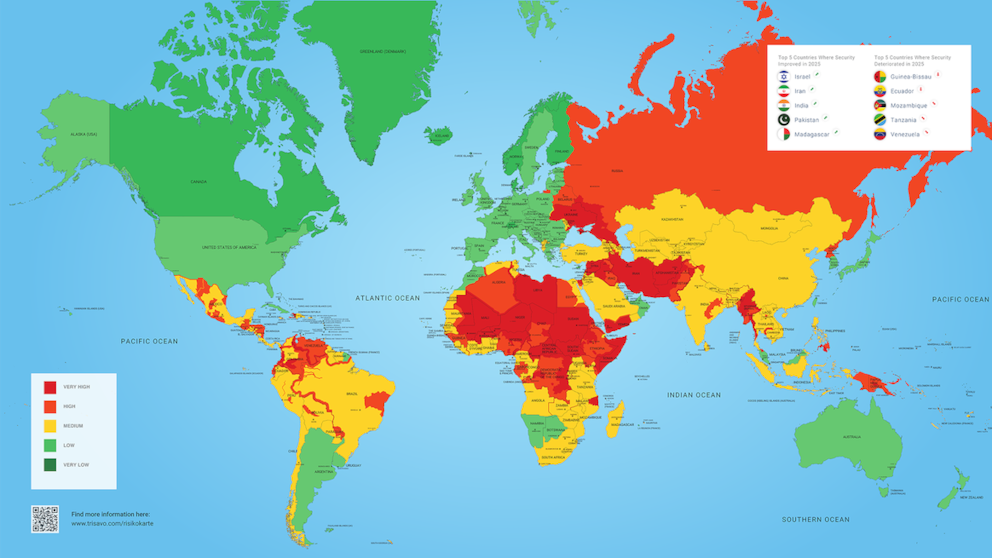
A3M uses five colors for the risk world map—dark green, light green, yellow, orange, and red—to depict the security situation in different countries. Not always is the entire country colored, but sometimes specific regions are. This allows for a detailed assessment of risks and helps travelers better recognize potentially dangerous areas and make informed decisions.
Dark Green: Very Low Risk
In countries colored dark green, according to A3M’s assessment, travel is possible without significant restrictions and is associated with very low risks. Violent crimes against travelers are rare, and natural disasters or health hazards are hardly expected. Should problems arise, a reliable healthcare system ensures safety. Additionally, infrastructure and transportation connections are at a high level.
Light Green: Low Risk
The countries can be visited with few restrictions. However, milder risks may be expected, about which travelers can inform themselves in advance (such as strikes, natural hazards, tropical diseases, or violent crime).
Yellow: Elevated Risk
According to A3M, countries colored yellow can be visited without major precautions. However, one is exposed to increased risks on-site. These could arise from health issues or political unrest, but “special risks” are also mentioned. One should inform oneself accordingly before traveling.
Orange: High Risk
In countries marked in orange, travel is only possible with significant restrictions and requires extensive precautions. The crisis specialists cite violent crime and terrorist organizations as risk factors.
Red: Very High Risk
These countries can be “traveled only with significant restrictions or not at all,” writes A3M. The experts strongly advise against it. There are dangers to be expected from, for example, a very tense political situation, violent crime, and a poor healthcare system.
The Most Insecure Countries in 2026 According to the Risk Map
The map shows shifts in risk zones compared to the previous year. In Latin America, the greatest deteriorations are no longer found in Mexico or Haiti, but in Ecuador and Venezuela. In Africa, the new focal regions are mainly on the east coast, such as in Tanzania and Mozambique. At the same time, a slight relaxation is visible in the Middle East, although analysts emphasize that the situation remains tense. Overall, the hotspots are shifting, while the extremely problematic countries remain critically unchanged.
Some of the world’s most insecure regions remain at a very high risk level. These include Afghanistan, Syria, South Sudan, Iraq, Myanmar, the Central African Republic, and large parts of Ukraine. The ongoing conflicts and structural crises in these regions prevent improvement. Thus, the Risk Map for 2026 confirms that certain global hotspots continue to be among the most dangerous travel destinations.
The Most Dangerous (and Safest) Countries and Cities in 2026
The Most Dangerous (and Safest) Countries in 2025
Countries with Deteriorated and Improved Security Situations
While in 2025, Bolivia, Haiti, Iran, Lebanon, and Mexico were cited as negative examples, the Risk Map for 2026 focuses on Guinea-Bissau, Ecuador, Mozambique, Tanzania, and Venezuela. The regional change is striking. For instance, Latin America remains a risk zone, but with new focal points. In Africa, states on the east coast have now particularly destabilized.
The new risk map also provides encouraging changes. While in 2025, Argentina, Armenia, Azerbaijan, Kosovo, and Moldova were highlighted as countries with a noticeable improvement in the security situation, the new Risk Map shows a significantly changed picture. Now Israel, Iran, India, Pakistan, and Madagascar are among the countries whose risk development has positively evolved. This new selection signals that the situation in several geopolitical tension areas has surprisingly relaxed, while previous positive trends—such as in the South American and Eastern European regions—have not continued.
The Safest Countries According to the Risk Map
Among the safest countries in the world, little has changed compared to the Risk Map for 2025. Norway, Finland, Switzerland, Japan, Canada, Iceland, Australia, and New Zealand consistently remain in the “very low risk” category, marked in dark green. These countries are characterized by a very low crime rate and stable political conditions, reliable healthcare, and well-functioning infrastructure.
Germany Rated as Low Risk
Germany is classified as light green, meaning a country with low risk. The situation has changed minimally since 2024: Back then, the Federal Republic was still considered “very safe” (dark green), but since 2025, the Risk Map indicates a “low risk.” Overall, most of Europe shows only minimal changes. France, Italy, and Spain were and are light green, while Switzerland, Norway, and Finland are still depicted in dark green. Ukraine and Belarus remain highly or very high-risk areas.