

November 18, 2026, 11:08 am | Read time: 10 minutes
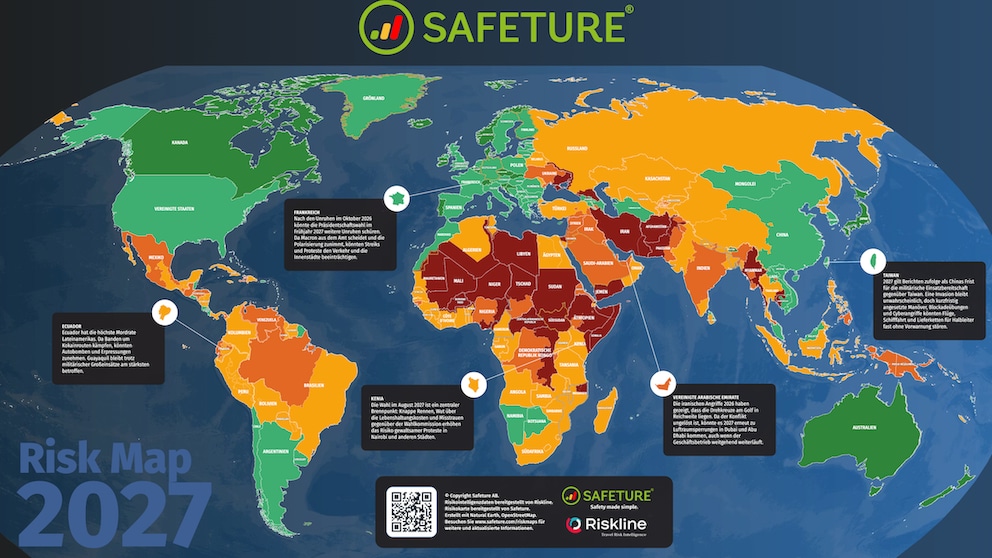
The security experts from the companies Safeture and Riskline have released their Risk Map for 2027. It highlights the safest and most dangerous countries in the world, as well as cities that travelers should avoid or can visit with confidence in the coming year. Additionally, the map shows countries that have undergone the most significant changes in travel risk over the past year. TRAVELBOOK presents the findings.
How safe is the world these days? Where can you travel with peace of mind, where should you be cautious, and which countries and cities should you avoid for now? The topic of safety continues to polarize, especially given the ongoing situation in the Middle East, the nearly five-year-long Russian war against Ukraine, the disastrous conditions in Sudan, and numerous other global crisis hotspots. Added to this are the sometimes devastating effects of climate change and security concerns such as domestic political situations, crime, and more.
To provide travelers (and everyone else) with an overview of the global situation, the Institute for Economics and Peace, among others, examines the state of peace and security worldwide in its annual Global Peace Index. Various companies also regularly publish updated Risk Maps, such as International SOS and A3M Global Monitoring GmbH.
Similarly, the partnered companies Safeture and Riskline release an annual risk map. This global Risk Map 2027 not only illustrates the situation in individual countries but also highlights which cities are currently particularly safe or unsafe. A section of the legend also addresses which countries have recently shown significant changes in their safety levels.
The Risk Map by Safeture and Riskline
The Swedish software company Safeture, which claims to offer a “platform for personnel risk management that helps companies protect their employees worldwide,” developed the global risk map. This was based on data from the Danish company Riskline, which specializes in analyzing global travel risks. The map itself is divided into five color gradations: dark green (negligible risk), light green (low risk), yellow (medium risk), orange (high risk), and red (critical risk). Factors such as security, crime, health and environmental risks, and local medical care are used to determine a country’s risk level.
Which data is used, where it comes from, and how exactly the safest and most dangerous cities and countries are determined is not detailed in Safeture’s current announcement on travel risks for 2027. In a previous statement, it was mentioned that more than 100,000 data sources are processed by AI-supported professional analysts at Riskline. The Riskline website previously stated: “We use proprietary technology that continuously monitors Open Source Intelligence (OSINT) for travel.” Accordingly, analysts review and verify information daily from sources such as local and social media, government advisories, law enforcement, emergency services, security forces, and disaster relief.
Inquired at Riskline
How exactly the lists of the safest and most dangerous countries and cities are created remains unclear. TRAVELBOOK has previously inquired with Riskline and Safeture. Nikita Billier, Security and Political Risk Analyst at Riskline, explained at the time: “When creating the security assessment for a specific country, we apply a structured risk level methodology based on internationally recognized risk management practices.” Each report evaluates five risk levels from low to extreme, reflecting both potential and actual impacts of a threat, as well as the likelihood of it occurring. Considered are “the implications for travel, personal safety, and, to a lesser extent, assets.” The likelihood of an event is assessed based on how likely or unlikely it is to occur. Billier said: “The final risk level results from the intersection of impact and likelihood (…).” This methodology is applied in country reports across several areas, including politics, conflicts, terrorism, unrest, crime, natural hazards, health risks, and local travel conditions.
The Situation in the World Changes Quickly
“This year’s map shows how quickly the risk landscape can change,” Jonas Brorson, Chief Marketing Officer at Safeture, is quoted in the company’s announcement on the current Risk Map. He explains: “Several Gulf states, considered stable economic centers by many companies, have risen by two levels within a single year—and even Germany and Finland are no longer at the lowest level.”
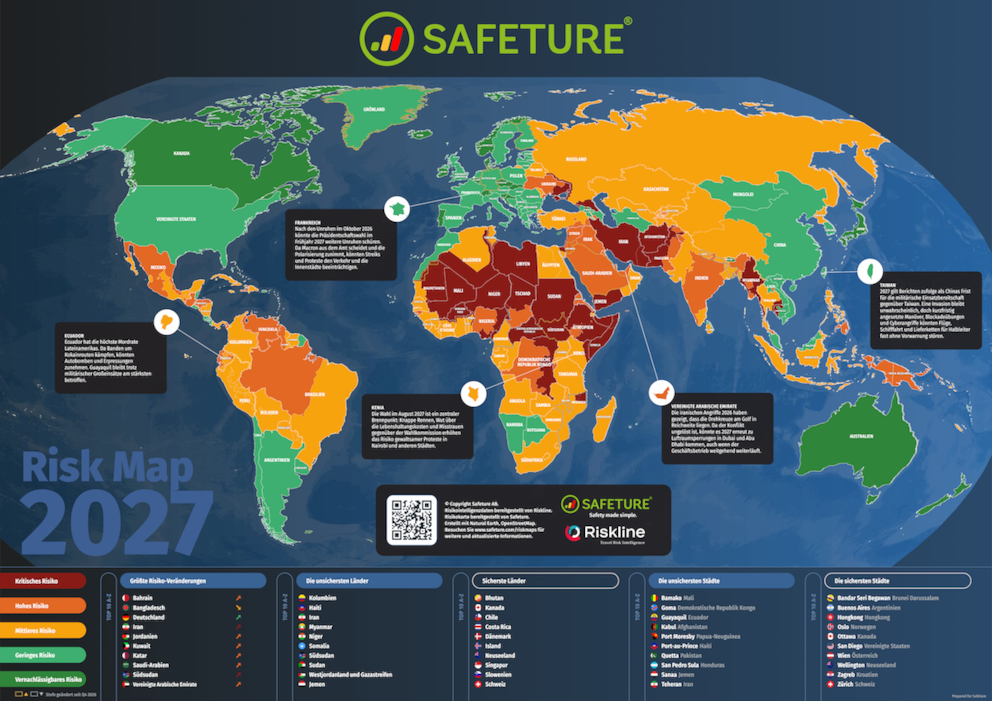
According to the Risk Map, the most significant deteriorations in travel risk are seen in the Gulf states and the Middle East. Following Iran’s attacks, the risk level in Bahrain, Kuwait, Qatar, and the United Arab Emirates each increased by two levels, from “low” to “high.” Oman also moved from its previously low risk to a medium risk on the current risk map. At the same time, the risk in Saudi Arabia and Jordan increased from a previously medium to a high level. Iran, due to the war with the U.S. and Israel and attacks on the mentioned neighbors, has risen from a previously high to the highest level, a critical risk.
And this region is not the only one appearing in the category of the greatest risk changes. There were also significant negative changes in South Sudan and Germany. According to the Risk Map, the latter does not show an excessively high security risk but has risen from its previously negligible level to a low level. The same applies in Europe to Finland, Cyprus, and Greenland.
In addition to 15 countries where the risk situation has worsened, six countries show improvements: Bangladesh, Cameroon, Mozambique, and Nepal have moved from a previously high to a medium risk. In El Salvador and the Maldives, there is currently no longer a medium risk but instead a low one.
The 10 Countries with the Greatest Changes*
- Bahrain
- Bangladesh
- Germany
- Iran
- Jordan
- Kuwait
- Qatar
- Saudi Arabia
- South Sudan
- United Arab Emirates
* According to Safeture, the order of the countries is not a ranking but an alphabetically ordered overview.
The Most Dangerous Countries in the World
Dangerous situations change quickly. Often, a security situation is altered by armed conflicts, as the list of Middle Eastern countries shows. Besides wars and armed attacks, it is often civil unrest, high crime rates, weak governments, and border conflicts that characterize the most dangerous countries in the world.
The list of these globally most dangerous countries has changed compared to the previous year. Last year, as in previous versions, it included Afghanistan, Myanmar, and Pakistan, as well as Ukraine, which remains at war with Russia. This year, the picture changes somewhat—although these countries still show at least partially dark red, indicating a critical risk. Sudan and South Sudan, Haiti, Myanmar, and Somalia remain on the list as in the previous year. Additionally, a few new names have been added.
The 10 Most Dangerous Countries and Regions in the World*
- Colombia
- Haiti
- Iran
- Myanmar
- Niger
- Somalia
- South Sudan
- Sudan
- West Bank
- Gaza Strip
- Yemen
* According to Safeture, the order of the countries is not a ranking but an alphabetically ordered overview.
These Countries Are Considered Safe
Amidst all the gloom (or dark red) in the world, it should not be forgotten that there are numerous destinations that travelers can visit without worry. A look at the Risk Map 2027 shows some dark green spots, indicating countries where the risk is “negligible.” Some of them are still located in Europe. The ten safest are (listed alphabetically):
- Bhutan
- Canada
- Chile
- Costa Rica
- Denmark
- Iceland
- New Zealand
- Singapore
- Slovenia
- Switzerland
Additionally, the following are also dark green and thus safe to travel to:
- Australia
- Belgium
- Ireland
- Japan
- Croatia
- Luxembourg
- Norway
- Portugal
- Slovakia
- Czech Republic
In addition, there are various light green countries on all continents, indicating a low risk. These include Spain, France, the United Kingdom, Sweden, Finland, Germany, Italy, the U.S., Argentina, Namibia, Botswana, China, Mongolia, and Vietnam.
Comparing the countries marked dark green with those on other global risk assessment maps and reports reveals many overlaps. For example, Iceland consistently ranks first in the annual Global Peace Index, and Ireland, New Zealand, and Switzerland also generally rank high. The names mentioned here with dark green markings were also found on the Risk Map by Safeture and Riskline from the previous year. Switzerland was not only considered generally safe, but the Swiss city of Bern was also listed as one of the safest worldwide in both 2025 and 2026.
The (Un)Safest Cities in the World
In addition to the various safe and unsafe countries, Safeture and Riskline also identify the safest and most dangerous cities in the world. Unlike the Risk Map 2026, only one city remains on the list of the safest cities for the coming year that was also listed last year: Ottawa, Canada. All others are new additions. Last year, Munich was among the safest cities worldwide, but this year no German city appears on the list.
The 10 Safest Cities 2027*
- Bandar Seri Begawan, Brunei
- Buenos Aires, Argentina
- Hong Kong, China
- Oslo, Norway
- Ottawa, Canada (also 2025 and 2026)
- San Diego, USA
- Vienna, Austria
- Wellington, New Zealand
- Zagreb, Croatia
- Zurich, Switzerland
* According to the Risk Map 2027 by Safeture and Riskline, in alphabetical order
The safest cities in the world, according to an earlier report by Safeture, have low crime rates, effective police work, and stable government leadership. In contrast, the most dangerous cities worldwide experience combat and unrest. They also often struggle with organized crime.
The list of the ten most dangerous cities for the coming year includes some familiar names from previous years. These include Goma, Kabul, Port-au-Prince, Port Moresby, and Quetta.
The 10 Most Dangerous Cities 2027*
- Bamako, Mali
- Goma, Democratic Republic of the Congo (also 2026)
- Guayaquil, Ecuador
- Kabul, Afghanistan (also 2026)
- Port-au-Prince, Haiti (also 2025 and 2026)
- Port Moresby, Papua New Guinea (also 2025 and 2026)
- Quetta, Pakistan (also 2026)
- Sana’a, Yemen
- San Pedro Sula, Honduras
- Tehran, Iran
* According to the Risk Map 2027 by Safeture and Riskline, in alphabetical order
Countries to Avoid Traveling to in 2026
The Most Dangerous (and Safest) Countries in 2025
Risks, Especially for Female and LGBTQ Business Travelers
The Risk Map and its subcategories are to be understood as general risk assessments. Depending on the population group, the risk may be higher or lower. Riskline explains in a statement on this year’s risk map: “Local laws, cultural attitudes, and geopolitical instability pose particular security risks for female and LGBTQ business travelers.”
The company names Estonia, Denmark, and Austria as three of the safest travel destinations for women. In contrast, Afghanistan, Haiti, and India are considered the riskiest by them. The list differs for LGBTQ travelers. According to Riskline, Iceland, Norway, and Thailand are considered particularly safe, while Iran, Saudi Arabia, and Brunei are classified as high-risk. However, the situation can change, and quickly. “A fixed list of places to avoid is no longer sufficient,” Adam Schrader, Operations Manager at Riskline, is quoted in the statement. He recommends for 2027 that “organizations should evaluate each trip individually and consider whether the traveler can undertake the journey with the right preparations at that time.” This also applies to tourists and other individual travelers.
Outlook
The outlook for the future remains rather bleak at Riskline, as the geopolitical landscape remains challenging, the company writes. Already this year, the conflict between Iran, Israel, and the U.S. has led to significant changes in the risk levels of the Middle East. At the same time, risks in the Baltic states and Romania have increased due to the war between Russia and Ukraine. For the future, Riskline expects “that political transitions, elections, youth-led protests, and regional conflicts will shape travel security in 2027.”