

April 11, 2025, 10:08 am | Read time: 6 minutes
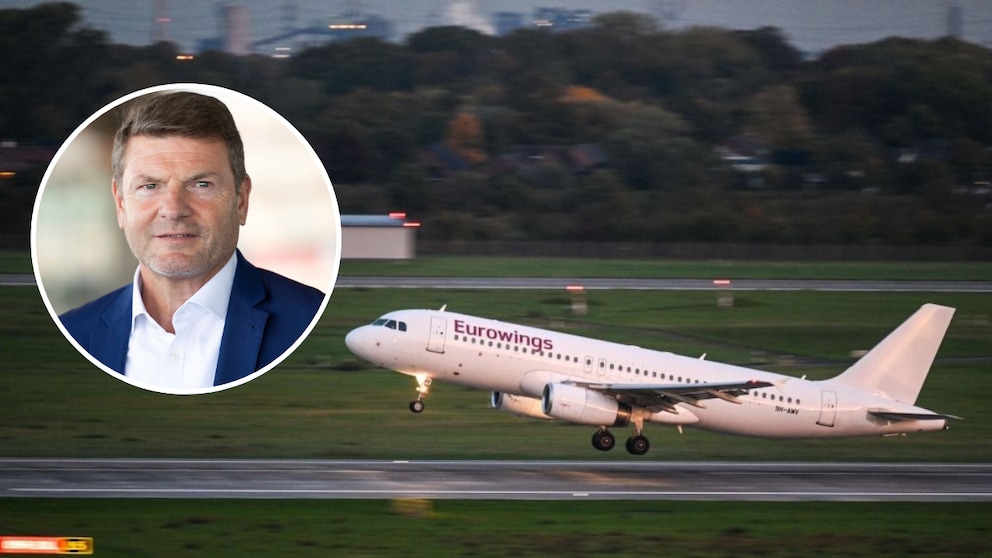
Germany is currently undergoing a transformation thanks to the new government. This is evident in the aviation industry as well. What needs to happen to ensure we don’t fall behind as a business location? Where is there still a need for action in infrastructure? And what happens if aviation in Germany isn’t relieved soon? Jens Bischof, CEO of Eurowings, has found clear answers to all these questions in an interview with TRAVELBOOK.
Overview
Expectations from the Eurowings CEO for the New Federal Government
Mr. Bischof, Germany can now access a special fund of 500 billion euros for infrastructure. That must surely please you as the head of Eurowings.
Jens Bischof, CEO of Eurowings: “Given the ongoing economic crisis in Germany, it is imperative to direct substantial funds into infrastructure, which includes aviation. A modern, efficient transportation infrastructure is a key driver for growth and prosperity. Unfortunately, the importance of a functioning economy for a nation’s well-being has faded into the background in recent years.”
What do you expect from the federal government?
“That investment is also made in aviation infrastructure. Mobility is crucial for connecting people, cultures, and entire economies. And I don’t just mean private and vacation travel, but also business trips. Global passenger traffic in aviation increased by more than ten percent in 2024 and is now above pre-pandemic levels–except in Germany. No wonder we’re falling further behind economically.”
Is it only due to the ecological awareness of people here?
“We know that the extremely high costs at the German location are responsible for the decline. State-induced costs alone amounted to 3.3 billion euros last year. This year, the aviation industry is expected to shoulder an additional 1.2 billion euros. In total, 4.5 billion euros are added to each flight ticket, which is unprecedented in Europe. The future federal government must act now to stop this cost avalanche.”
What do you specifically wish for?
“Two billion euros are solely due to the aviation tax, which has no earmarking. The money currently goes into the general tax pot, financing other state expenditures. Therefore, our appeal to the government is to follow Sweden’s example and abolish the aviation tax. Sweden is as environmentally conscious as we are but has recognized that national tax solutions only harm the domestic economy without helping the climate.”
Besides the aviation tax, there’s also the aviation security fee.
“This fee was also increased by up to 50 percent at the beginning of the year–from a maximum of ten to a maximum of 15 euros per passenger. This reflects our plight in Germany. In other countries, security checks are not only faster and more efficient but also much cheaper. Therefore, the future federal government should at least reverse the recent increase to 15 euros per passenger.”
Ticket Tax Decreases–Will Flying Become Cheaper Again?
Eurowings Expands Summer 2026 Flight Schedule From Berlin
Changes Needed for Aviation at Germany’s Business Location
Where do you see further need for action?
“During the pandemic, Deutsche Flugsicherung, like many other public or private companies, incurred losses. The government decided not to bear these losses as the owner but to add them to ticket prices. We currently have less passenger traffic than in 2019, but the fees for air traffic control are being doubled. Isn’t that absurd?
By 2030, 6 percent of aviation fuel must be sustainable. You yourself confirmed in an interview with us two years ago that Eurowings aims to halve CO2 emissions by 2030.
“First of all, the topic is very important to us as an industry. We take our responsibility in this area very seriously but need affordable, sustainable fuels to implement it. Today, so-called Sustainable Aviation Fuels (SAF) cost three to five times as much as conventional kerosene, and power-based fuels are up to ten times more expensive. At this level, no airline in the world can operate economically because it’s simply too expensive. Consequently, due to lack of demand, no large industrial plants are being built, and no SAF is being produced in sufficient quantities.”
That sounds like you’re asking for support …
“The U.S. shows how it’s done. Instead of penalizing their own aviation industry, they support sustainable fuels and even make them slightly cheaper. Through temporary subsidies, SAF becomes attractive, investment security in new plants increases–and with it the chance to lead a billion-dollar future market. We also call on the government to support sustainable aviation fuels. Only then can we ultimately achieve sustainability goals to which we are 100 percent committed. But we must finally break free from the punishment spiral in the form of taxes and dispel the misconception that artificially increasing the cost of flying in Germany helps the global climate.”
How many billions do you think are necessary?
“In my view, it is quite possible to decarbonize this industry with targeted and efficient efforts. Germany has substantial funds available from the infrastructure pot. They should now be used where they can have the greatest economic and ecological impact. Especially in aviation, this potential is significant.”
Germany Increasingly Dependent on Foreign Aviation
What happens if aviation in Germany isn’t relieved?
“A concerning trend will continue or accelerate: more and more industrial regions in Germany will be left behind, as we are already seeing in the Lake Constance region or at airports like Leipzig and Dresden. A direct aviation connection is a key success factor for the development of locations. The overall economic damage is immense if we continue to watch as more and more planes are stationed outside Germany. This makes us increasingly dependent on foreign aviation infrastructure.”
… which exploits these gaps for its benefit.
“Take Turkish Airlines, for example, which now flies to almost every corner of Germany and attracts more and more passengers through its hub in Istanbul. These airlines operate under entirely different rules regarding climate protection, taxes, and location costs. It’s high time to act because it’s about Germany as a business location–and about many jobs.”
Recently, there has been much discussion about Germany’s performance. Are our companies less efficient?
“Fundamentally, we don’t need to hide in terms of efficiency in the production of goods and services. However, access to raw materials in Germany is far too expensive. Whether it’s electrical energy, oil and gas, or aviation fuels: we have concrete blocks tied to our legs here. And where we want to achieve equal conditions for all with simple means, we end up creating bureaucratic monsters. An example is the blending quotas for SAF in European aviation. A super-complicated construct has been created here to check whether non-European airlines landing here have refueled enough in Europe. It would be much simpler to introduce a goal-oriented climate levy and use these revenues to ramp up sustainable aviation fuels, without bureaucracy and with cost-sharing by non-European airlines.”