

September 17, 2026, 3:19 pm | Read time: 4 minutes
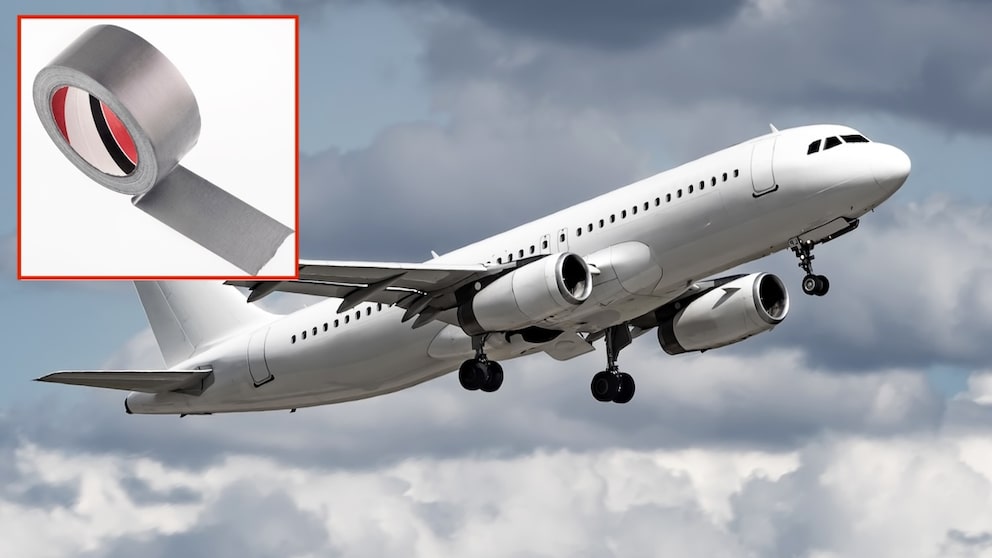
Why does the cabin crew actually have tape on hand? Many might ask this question after a case involving American Airlines made headlines: A disruptive passenger was restrained with tape to his seat during the flight. However, tape is not part of the standard equipment for cabin crews—at least for German airlines—as a flight attendant explained to TRAVELBOOK. The standard procedure for dealing with unruly passengers is quite different.
Airplane Disruptor Restrained with Tape on American Airlines
Here’s a quick recap of what happened. The passenger, Arthur Lundeen, appeared intoxicated on an American Airlines flight last week and began yelling at his seatmate, as reported by BILD. He became increasingly aggressive, hurling racist and homophobic insults at passengers. He also became physically aggressive toward other passengers and the cabin crew. Other passengers, including one named Richard O’Lenick, eventually managed to subdue him. With the help of zip ties and tape provided by the cabin crew, Lundeen was restrained to his seat. O’Lenick captured the bizarre scene and posted it on Instagram.

German Flight Attendant Familiar with Similar Situations
Such incidents are not limited to American airlines. German airlines also frequently encounter aggressive or disruptive passengers.
Also interesting: Up to 20,000 euros! France introduces harsh penalties for disruptive passengers
TRAVELBOOK spoke with a flight attendant from a major German airline who wished to remain anonymous. She recalled an incident from last year: On a Lufthansa flight from Mexico City to Frankfurt, a passenger began acting out shortly after takeoff. The crew restrained him, but he managed to free himself and continued to be aggressive. The cockpit crew then decided, for safety reasons, to turn back over the Gulf of Mexico and return to Mexico City, where the passenger was arrested by police.
Methods for Handling Unruly Passengers
She was not on the flight in question. However, she frequently encounters “unruly passengers” on board—a term used in aviation for disruptive passengers. The use of tape is “certainly not a standard procedure.”
There is usually no tape in the cabin—perhaps only in the cockpit, for temporary fixes, such as securing a fallen mirror in the restroom. For aggressive or disruptive passengers, there are established protocols. “When you’re at 25,000 feet, you can’t just land.” The crew must remain capable of action and be able to secure a passenger if necessary. “We have handcuffs to restrain passengers who become a threat to other passengers and the crew.” Passengers are not tied to their seats; only their hands are secured with restraints.

Why Some Flight Attendants Sit on Their Hands During Takeoff and Landing
Shocking! Survey Reveals Many Pilots Fall Asleep While Flying
Crews Rarely Resort to Tape
This last point is particularly important. In emergencies, aviation regulations require that an aircraft can be evacuated within 90 seconds. This explains why passengers—whether disruptive or not—should generally remain mobile. In such a short time, the cabin crew must ensure that all passengers can exit the aircraft.
The equipment for dealing with misbehaving passengers includes plastic handcuffs and, depending on the airline and procedures, other restraints such as zip ties or special straps. The use of tape is not a standard procedure for cabin crews. The International Air Transport Association (IATA) describes measures such as de-escalation and training flight attendants to handle “unruly passengers.” The use of appropriate restraints and, if necessary, diverting the flight are also mentioned as possible measures.
Yet, there have been cases in recent years where extremely aggressive passengers were restrained with tape. One such incident occurred in 2021 on United Airlines; Newsweek reported on it. The airline apparently even advised its crews that tape should not be used as a regular restraint.
Disruptive Passengers Are a Growing Problem
According to recent analyses, unruly passengers are becoming an increasing problem for flight safety. In 2021, there was an incident with a disruptive passenger on one out of every 835 flights, while in 2023, it occurred on one out of every 480 flights. The European Union Aviation Safety Agency (EASA) also reports a continuous increase in the number and severity of such incidents. In Germany, 160 cases were reported to the Federal Aviation Office in 2024.