

May 8, 2026, 8:15 am | Read time: 4 minutes
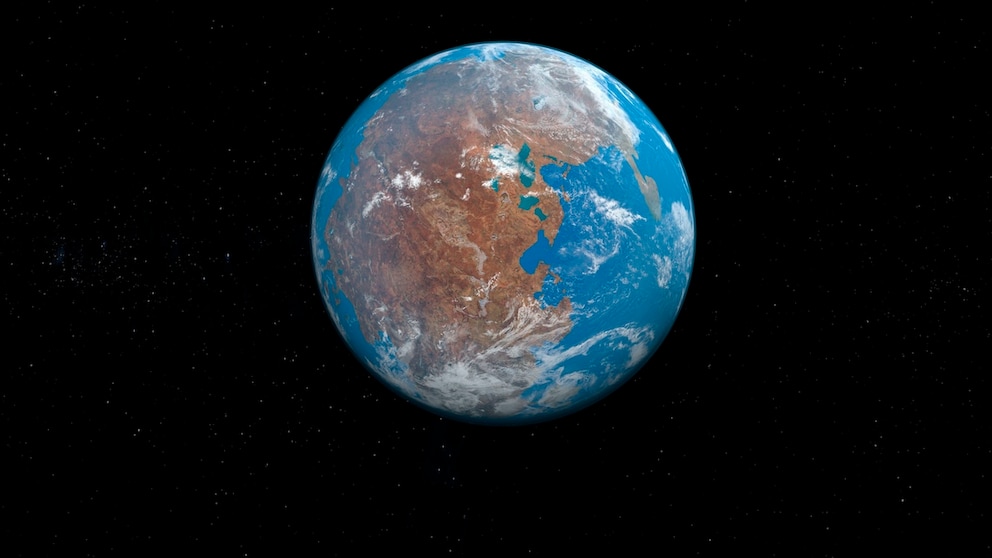
Idyllic at the forest’s edge or urban in the middle of the city—in an old apartment or a prefab building: Your home likely feels very “stable.” You go to bed tonight and don’t suddenly wake up in a different neighborhood or even on another continent. But if you look back millions of years, that was quite normal for Earth. The patch of land you now call your hometown was once in a completely different position on the planet. But where exactly? This can now be calculated with an innovative interactive map.
Why Your Hometown Was Once Located Elsewhere
The fact that continents don’t always stay in the same place is due to what are known as tectonic plates. As you probably know, Earth’s surface consists of several massive rock plates that “float” on hot, viscous material inside the Earth and move extremely slowly. On a human timescale, this is barely noticeable—just a few centimeters per year. However, over millions of years, this movement adds up to thousands of kilometers.
This changes entire oceans and continents: Seas open and close, landmasses drift apart or collide, and mountains form where plates meet. For example, India was once an isolated landmass south of the equator before it collided with Asia, forming the Himalayas. Europe and North America were also once part of a connected continent—the Atlantic Ocean did not exist back then.
This also means that your current hometown was once somewhere else, just like every other place on Earth. And you can now find out more about this using the platform Paleolatitude.org.
How the Innovative Tool Works
The new online tool can calculate where a current location was millions of years ago. And, very importantly: at what latitude. This value is crucial because it is directly related to climate. It determines how much sunlight an area receives and whether it has tropical, temperate, or polar conditions. This also helps explain which animals and plants could live there.
Technically, the tool works by linking a location’s current position with a geological movement model of Earth’s plates. This model describes how the plates have shifted and rotated over hundreds of millions of years. Essentially, time is “rewound”: From the current position, it calculates where this point was on an earlier version of Earth.
For us, this is probably just a fun exercise. For research, however, the improved reconstruction methods allow for a much more accurate understanding of which climate zones dinosaurs lived in or why certain species only appeared in specific regions.

Researchers Discover Gigantic Structure Beneath Bermuda
Researchers Solve Mystery of River That Flows ‘Uphill’
How the Interactive Map Was Developed
The new model is considered significantly more precise than previous approaches. It allows for the first time a detailed tracing of highly deformed regions like mountains or collision zones. The scientists responsible have described detailed information about its development in a research paper.
A central role is played by paleomagnetism. Certain minerals in rocks store the direction of the Earth’s magnetic field at the time of their formation—similar to a “frozen compass.” Since the magnetic field runs roughly from the equator to the poles, it can be deduced at which latitude a rock was formed.
The researchers combine this information with comprehensive models of plate tectonics and new geological reconstructions. A major advancement of the current version is that uncertainties are systematically calculated. Neither the age of fossils nor the exact former location of a rock can always be precisely determined. Instead of outputting just a single value, the model also calculates possible deviations, making the results statistically more robust.
For the development, a global model of the past approximately 320 million years was created. The researchers not only reconstruct continents and oceans but also vanished sea basins, micro-continents, and ancient island arcs that have now merged into other landmasses.
What Users Can Expect from the Interactive Map
You shouldn’t expect the tool to provide an exact historical address. It doesn’t say, “a specific city was located here,” but rather assigns a location to a geological position and, most importantly, a climate zone.
If a result indicates a paleolatitude of 20 degrees north, it doesn’t mean a comparable modern city, but that the location was in a much warmer, often subtropical zone at the time. The current hometown is treated as a reference point on a moving tectonic plate. The system calculates the journey of this plate over time, resulting in the earlier geographical location.