


February 19, 2026, 3:56 pm | Read time: 8 minutes
Experts have long tried to dispel the notion of sharks as bloodthirsty killers of the seas. In reality, the animal is more curious, and humans are not part of its natural diet. Yet, in extremely rare cases, bloody or even fatal attacks occur. TRAVELBOOK reveals where most of these incidents happen and has spoken with experts on how to best react during a shark attack or, ideally, avoid one altogether.
The United States is the country with the most documented shark attacks on humans worldwide. The number of 1,698 documented cases may seem high at first glance. However, the data from the International Shark Attack File (ISAF) dates back to 1580. This means that in the past approximately 445 years, there have been an average of just 3.82 shark attacks per year in the U.S. The German Shark Foundation explicitly refers to these incidents as shark accidents rather than attacks, as humans are not prey for these predators and often intrude into their habitat.
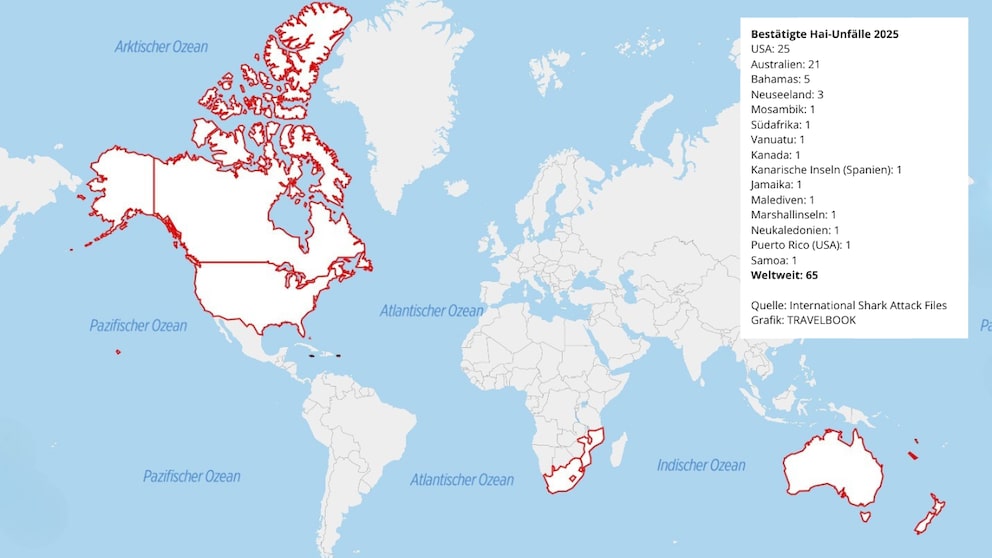
65 Shark Attacks Worldwide in 2025
Looking at the year 2025 alone, as shown on the map above, there were a total of 65 shark attacks worldwide, nine of which were fatal, according to ISAF. ISAF only counts “unprovoked bites,” meaning incidents where a shark bites a human in its natural habitat without prior provocation. In contrast, “provoked bites” occur when a human initiates interaction with a shark in some way. “This includes cases where divers are bitten after harassing or touching sharks, bites on spearfishers, people trying to feed sharks, or when removing a hook or freeing a shark from a fishing net,” ISAF writes.
Last year, with 25 recorded cases, the U.S. again topped the list of countries with the most shark attacks, followed by Australia with 21 cases. Combined, these two countries accounted for more than 70 percent of all shark incidents worldwide in 2025. Compared to other types of injuries or unnatural deaths, these numbers are still negligible. Shark expert Dr. Philipp Kanstinger from “WWF Germany” told TRAVELBOOK: “More people die from champagne corks than from sharks.” Yet, many vacationers still swim with fear.
What to do in the rare event of a shark attack, how useful the tip is to avoid wearing perfume, and how to best prevent an attack—TRAVELBOOK reveals the most important (survival) tips from experts at the International Shark Attack File (ISAF), the shark research center at the University of Florida, and Philipp Kanstinger.

What Should I Do if I Encounter a Moose While Hiking?

This German Dives with Great White Sharks—Without a Cage!
Avoiding Shark Attacks
Avoid Wearing Perfume While Swimming?
After two fatal shark attacks in the Red Sea in 2022, Egyptian authorities, according to the online portal “Nau.ch,” gave tips to avoid such attacks. One of them was to avoid wearing perfume while swimming. “Nonsense!” says shark expert Philipp Kanstinger. “That certainly wouldn’t be the reason a shark attacks or not.”
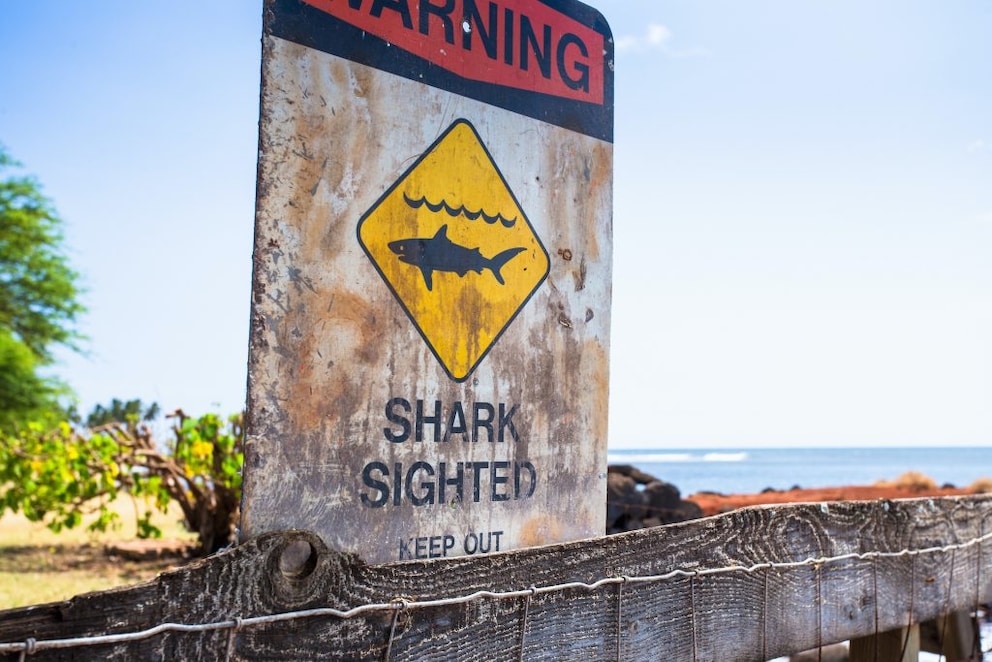
It is especially important to “listen to the locals, heed warning signs in regions known for shark attacks, and never provoke sharks.”
Avoid Swimming in Risk Zones
Avoid murky waters, as both sharks and you have little orientation. Accidents are more frequent here, though still extremely rare. The same applies to river mouths, sandbanks, harbor areas, steep coasts, and other places teeming with prey for sharks. There is also an increased risk in areas where edible waste is discharged into the sea. You should also avoid swimming near sport fishers, as sharks are attracted by the catch and the struggling fish.
Don’t Swim Alone, Especially Not at Night
Do not go into the water alone; shark attacks on groups are rarer. Avoid shark-infested waters at night or during twilight.
Avoid Wearing Jewelry
Bright swimwear and shiny jewelry can also increase the risk of an attack, possibly due to being mistaken for fish.
No Dogs in the Water and Don’t Flail
Experts also advise against swimming with dogs and horses, as their movements attract sharks. For the same reason, people should not flail in shark-infested waters.
Don’t Swim Too Far Out
If you stray too far from the shore, help is not in sight in case of an emergency, and the way out of the water is very long.
Be Alert
Observe your surroundings: If fish or sea turtles flee, it could be a sign of predators. Withdraw cautiously.
The same applies if you see a large number of fishing seabirds or many dolphins: They indicate schools of prey fish that also attract sharks. Avoid such areas.
Trust Your Instinct!
If you feel uneasy, even for no apparent reason: Trust your instincts and leave the water. Your instinct can warn you of danger. This is even advised by the not-at-all-esoteric scientists from the shark research institute.
Stay Calm!
If you encounter a shark: Stay calm, even if it’s difficult! Often, the fish is just curious or there by chance—after all, you are in its natural habitat, essentially its living room. Premature defensive attempts could turn an otherwise harmless situation into a nightmare. As a rule of thumb, Philipp Kanstinger recommends: “If sharks are more than 1.5 meters away, they do not attack in 99.999 percent of cases.” Humans are not on the menu, Kanstinger explains: “The shark does not recognize humans, land creatures, as prey. Unlike marine mammals, humans have too little fat content and are not part of the over 400-million-year-old prey spectrum of these highly specialized predators.”
Be attentive, but calm and relaxed: With this mindset, you are safest, experts agree. If you suddenly panic in the water, remember that shark attacks are extremely rare.
In 2015, according to CNN, six people worldwide died from shark attacks. This is far fewer than those killed annually by dog bites or lightning strikes, as statistics have shown.
Maintain Eye Contact
However, you should never turn your back on the shark, so it cannot circle and surprise you from behind. Align yourself back-to-back with your snorkeling or diving partner to keep an eye on everything. Be sure not to block the shark’s path to the open sea, so it doesn’t feel threatened. Even if you are alone and surprised by a shark, Philipp Kanstinger recommends maintaining eye contact and slowly swimming to shore.
Lead the Shark by the Nose
If the shark gets too close, Kanstinger advises pressing the shark’s nose down and “redirecting” it.
But what if the shark doesn’t move on and perhaps even appears aggressive? Playing dead is not a good idea, experts say. Panicked attempts to flee are also dangerous, as they could further confuse the shark and provoke attacks.
What to Do in a Shark Attack?
Show You’re Not Prey!
Although humans are not prey for these predators, attacks occur in rare situations, usually as a curious test, a defensive reaction, or a misunderstanding. According to Philipp Kanstinger, the most dangerous shark species for humans include tiger sharks, bull sharks in murky waters, and great white sharks, which pose a particular threat to surfers.
If things get dicey: Face the animal, shout at it, and defend yourself. Show it who it’s dealing with! Panicked flight movements, on the other hand, could reinforce the shark’s mistaken belief that it has caught one of its favorite prey animals—and it is definitely faster than you.
Defend Yourself–But Correctly!
If the shark still attacks you and you have no choice but to fight, experts recommend the following: Defend yourself using objects, such as your camera or surfboard.
Only if you have nothing with you should you use your hands. Punches or claw grips are most effective on sensitive areas like the eyes or gills.
Stop Bleeding!
At the moment of biting, the shark realizes it hasn’t caught prey and usually releases the victim—hence these attacks are also called test or mistaken bites, which are still extremely dangerous for humans. However, it is not the bite itself but the consequences, such as shock or circulatory failure, that are often the cause of death in fatal shark attacks.
Blood loss is also a significant danger. If you’re wearing a wetsuit, don’t remove it unless heavily bleeding injuries cannot be otherwise bound. The wetsuit can act as a lifesaving pressure bandage. Bleeding should be stopped immediately, even if you’re still in the water.
Get Out of the Water–Quickly, But Calmly!
Even though it’s unlikely the shark will repeat its “mistaken bite,” you should still leave the water immediately for safety, if only to seek medical help. Remove yourself as effectively, quickly, and calmly as possible, as panic could potentially provoke another attack.
Even if you don’t feel any pain, you should return to the boat or shore and check if you’re truly unharmed. There have been reports of victims who didn’t even notice their injuries.
Seek Immediate Medical Attention!
Experts advise seeking medical help on-site immediately, no matter how small the wound appears.
Shock and hypothermia can also be dangerous. Avoid unnecessary movement (or the victim, if you’re assisting someone else) and keep warm, for example, with a blanket.
First Aid for All Cases
Experts also recommend regular first aid courses: “Many deaths could have been prevented if arterial bleeding had been recognized in time and the correct first aid measures had been taken before rescue services arrived,” warn the scientists from the “Shark Attack Files.”