

June 14, 2023, 12:30 pm | Read time: 8 minutes
Where is the world’s oldest tree located? The answer isn’t clear-cut. The world’s oldest tree is either 5,000, 5,400, 9,500, or even 80,000 years old. It all depends on the definition. TRAVELBOOK introduces four ancient plants that could claim the controversial title.
When it comes to the world’s oldest tree, scholars disagree. Some believe the tree is in Sweden, others in California or Chile. There’s also a unique plant that resembles a forest more than a traditional tree, and there are even recordings of what this “tree” sounds like. TRAVELBOOK spoke with a forestry scientist and presents the contenders for the title.
The Oldest Trees in the World
Pando in Utah, approx. 80,000 years old

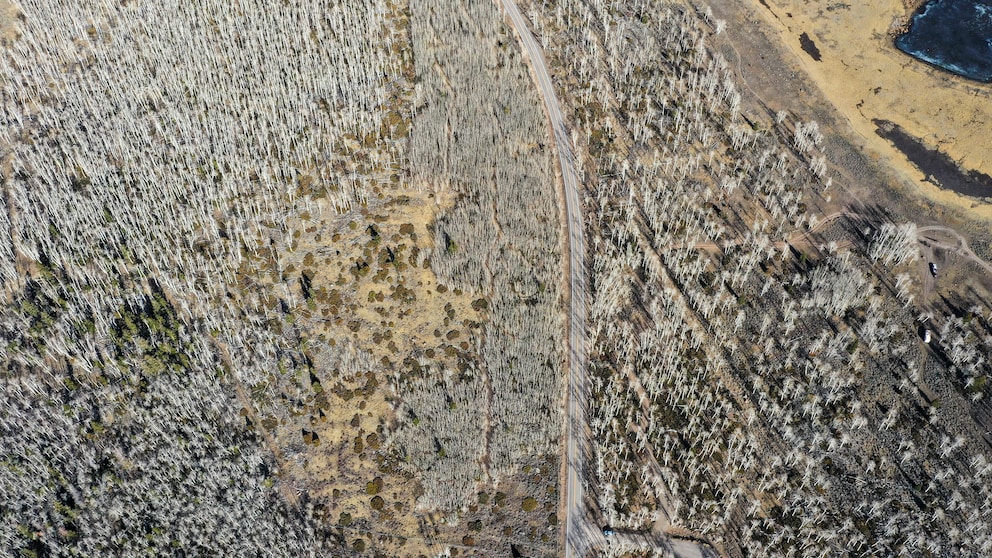
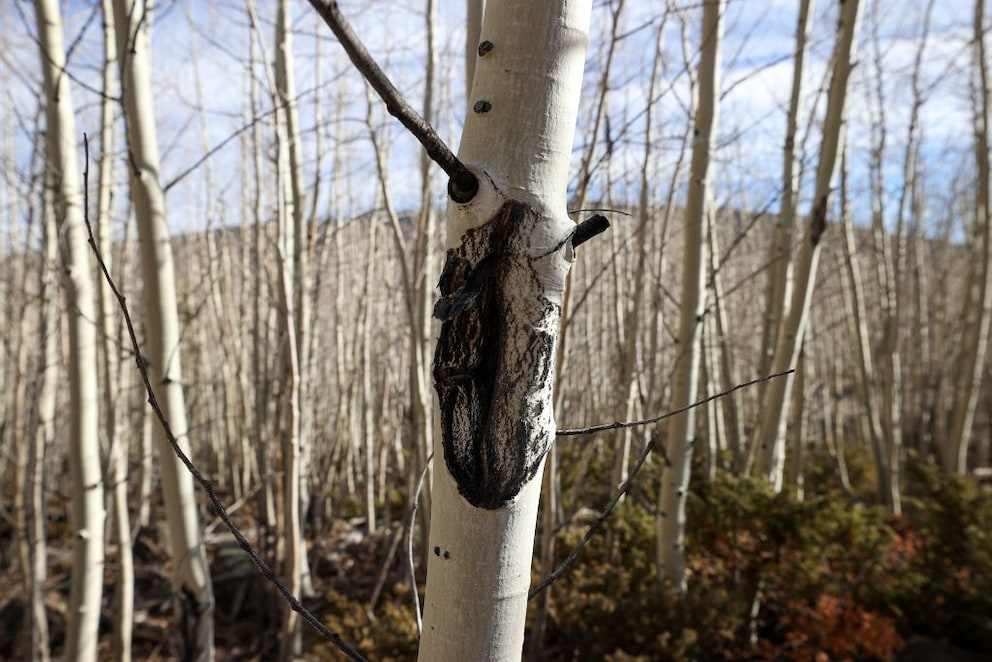
Not really a tree, but more of an entire forest, the clonal colony “Pando” is located in Fishlake National Forest in Utah, USA. The American quaking aspen has been growing for an estimated 80,000 years and now covers an area of 43.6 hectares. “Pando” is thus the oldest living organism in the world and also holds another record: At 6,000 tons, the quaking aspen is the heaviest living organism in the world.
Recently, you can even hear what this gigantic organism sounds like. Jeff Rice, a sound designer at Montana State University, captured the sounds of the giant by attaching a special microphone to the root of a trunk about 30 meters high. Here you can listen to the recording. You can hear a deep rumble, which Rice believes comes from the vibrations transmitted into the ground by the many trunks. And there are quite a few of these trunks. “Pando” now consists of approximately 47,000 trunks, all connected underground by a common root system and sharing the same DNA.
Pando is Threatened
However, in recent years, the growth of the giant has slowed, with fewer young trunks emerging. There are several reasons for this, as reported by “CNN.” In addition to changing climate conditions and fungal diseases affecting the main trunks, other living creatures pose the greatest threat: deer, elk, and moose that eat Pando’s young shoots. This means that in large parts of Pando, little new growth is occurring. The tree is therefore at risk of extinction.
While concern for Pando is justified, there’s no need to worry about the world’s oldest tree. According to forestry scientist Prof. Dr. Roloff, it is a living organism, not a single tree. “The first trees of ‘Pando’ are long dead, as this tree species only lives to be 200 years old. The current representatives are, so to speak, the great-great-great-great-grandchildren, all descending from the same tree,” Roloff explains to TRAVELBOOK. So, Pando is out of the running for the title. Who else remains?
This tree didn’t make it among the oldest trees in the world, but it’s still a true wonder of nature: Up to 5,000 years old! The oldest olive tree in the world still bears fruit
Old Tjikko in Sweden, approx. 9,550 years old

When it comes to the world’s oldest tree, this candidate is often mentioned. It is a Norway spruce, called “Old Tjikko,” located in Fulufjället National Park in Sweden. The seemingly unimpressive little tree is said to be a proud 9,550 years old. This was determined through radiocarbon dating of the root system. The tree and its extraordinary age were discovered by Leif Kullman, a professor of physical geography, who named the tree after his dog, the husky Old Tjikko.
The five-meter-high trunk is only a few hundred years old–the truly impressively old part of the tree is, like Pando, underground: its root system. “Old Tjikko” is an individual clonal tree. The trunk itself only lives about 600 years, but the root system survives the trunk and forms a new one once the old one dies, Kullman told “National Geographic.”
As impressive as that sounds, Prof. Dr. Roloff doubts this result. Almost 10,000 years ago, it was still too cold in the Swedish mountains due to the Ice Age, he explains to TRAVELBOOK. Therefore, the root age is not credible. If you consider not just the root system but the entire plant, including the trunk, there is an even older tree more than 8,000 kilometers from “Old Tjikko.”
Also interesting: Hyperion–the tallest tree in the world
Germany’s oldest tree is up to 1,300 years old.

7 Natural Wonders in Northern Tenerife You Should See
Bristlecone Pine in California, approx. 5,070 years old

The tree that was recently considered the oldest in the world is located in the White Mountains in California. The age of the Bristlecone Pine (Pinus longaeva) was determined in 2012. Accordingly, the tree is now an impressive 5,070 years old. To protect the tree from visitors, its location is kept secret. Before the 2012 measurement, the Bristlecone Pine “Methuselah” was considered the oldest tree in the world, being more than 4,800 years old. Another remarkably old Bristlecone Pine was felled in 1964 before its age was known. At the time of felling, “Prometheus,” as the tree was named, was 4,862 years old.
It’s particularly fascinating that plants are not limited by mortality as we know it from humans and other animals. Instead, their genetic material determines how old a plant can get. And with trees like the Bristlecone Pine, there doesn’t necessarily have to be an end, as the tree can continually renew itself. “A tree renews part of its tissues in almost all its organs every year: It sprouts new leaves and branches, forms a new growth ring in the wood, and new phloem cells in the bark, as well as new roots, so the youngest organs and organ areas are usually no more than a year old,” explains Prof. Dr. Roloff in his book “Handbuch Baumdiagnostik,” referring to the mentioned organs as leaves, branches, the trunk, and roots. New branches and roots can ensure the tree’s survival while certain parts die off.
Climate Contributes to the Longevity of the Bristlecone Pine
Long-lived tree species must have developed a variety of mechanisms to protect them from environmental influences such as pests, diseases, and damage over a long period, says Prof. Dr. Roloff. “For example, the climate of the Bristlecone Pine’s location contributes: It’s cold, and the growing season lasts only three months–this, in turn, keeps pests in check,” the forestry scientist tells TRAVELBOOK. Additionally, the Bristlecone Pine slows its growth due to the harsh winters, which also slows its aging.
Also interesting: 6 great examples of where humans respect nature
However, self-renewal is also the reason for the demise of these ancient creatures. If the path from the roots to the tip of the branches is too long, nutrients and water cannot reach the farthest ends of the tree. The “tree system” no longer functions as a whole because the nutrient exchange between the root and crown can no longer occur sufficiently, explains Prof. Dr. Roloff. However, new research suggests that the Bristlecone Pine may not be the oldest tree in the world; instead, a nearly 400-year-older Patagonian cypress is said to stand in Chile.
Gran Abuelo in Chile, approx. 5,400 years old

About 5,400 years ago, a seed is said to have germinated in Chile’s Alerce Costero National Park, surviving fires and logging, and has now grown into a tree with a diameter of almost four meters: “El Gran Abuelo,” or “Great Grandfather” in English. The tree, more than 60 meters tall, is thus one of the potential oldest living organisms in the world. According to Chilean researcher J. Barichivich, there is an 80 percent probability that the tree, originally estimated to be about 3,500 years old, is actually more than 5,000 years old.
However, other scientists are skeptical, mainly due to Barichivich’s unconventional measurement techniques. Instead of examining the tree’s growth rings as usual, he took only a partial core sample and created a model based on similar trees to determine the (supposed) age of the tree. This was criticized by Ed Cook of Columbia University, who told “Science” that the “only way to truly determine a tree’s age is through dendrochronological ring counting.”
Regardless of the controversial discussion about measurement methods, Barichivich says that the title is not the most important thing, but rather the protection of the tree. The tree’s root system has long suffered from being a tourist attraction in Alerce Costero National Park.