

June 14, 2026, 10:56 am | Read time: 4 minutes
Near Stavenhagen in Mecklenburg-Vorpommern lies an impressive natural wonder. A forest where several oak trees grow, some said to be over 1,000 years old. The Ivenack Oaks are well-known beyond Germany’s borders, with the mightiest among them being the largest pedunculate oak in the world. TRAVELBOOK author Robin Hartmann visited these gnarled giants for you.
For years, a friend kept telling me about the Ivenack Oaks and how he wanted to visit them. But, as life often goes, something always got in the way. Until recently, on the way back from a paddling tour on the Peene with two other old friends, I suddenly spotted a sign by the roadside.
I briefly recounted the story of the trees that I had heard about, and to my delight, they were up for a visit. I wondered if reality could match the legendary tales of the trees that I had listened to with fascination for years. Spoiler alert: In the end, all my expectations were far exceeded.
Awe-Inspiring Dimensions
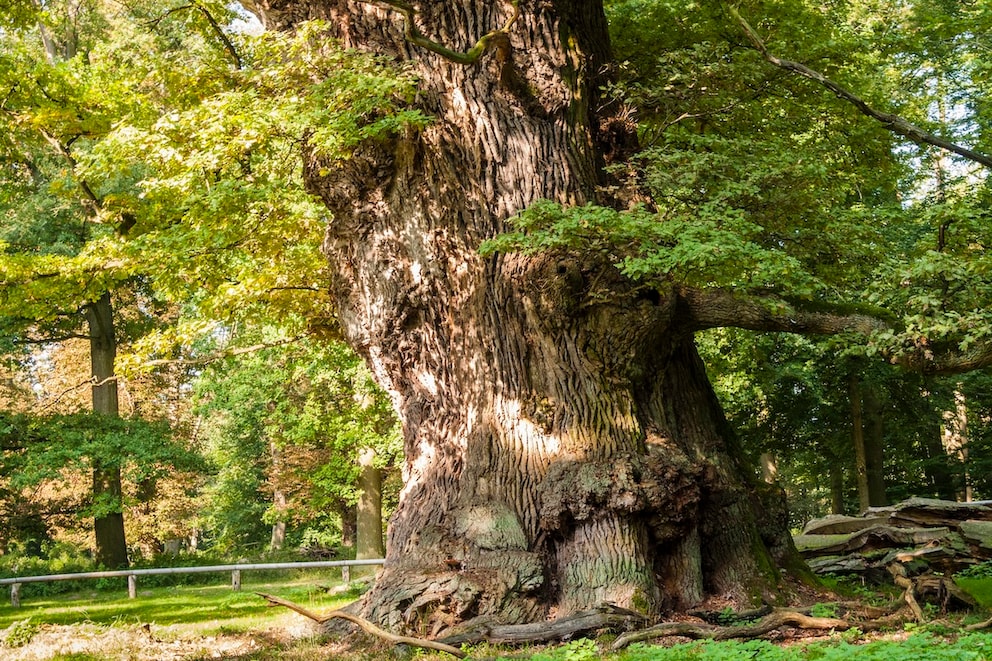
We drove along increasingly narrow country roads until we finally turned into a parking lot that was still quite full despite the late hour. Swarms of mosquitoes circled us, and thanks to the holiday, we passed an entirely deserted ticket booth and entered the sacred tree halls. We found ourselves in a so-called “Hutewald,” a forest created by centuries of grazing animals. Over time, these animals repeatedly ate the shoots of young trees, allowing only particularly robust specimens to survive.
The forest appeared both dense and incredibly light. The evening sunlight filtered through the crowns of the giant trees, not just oaks, creating a magical atmosphere. Especially when we reached the first of the five Ivenack Oaks after just a few steps. Signs inform visitors about the special trees and their dimensions. The oldest specimen, also known as the “Methuselah Oak,” has a trunk circumference of about 11 meters and is estimated to be around 1,000 years old. This becomes particularly impressive when you consider the actual time intervals involved. When Columbus discovered America, Methuselah was already almost 500 years old. Today, it is considered the largest pedunculate oak in the world.
Germany’s oldest tree is up to 1,300 years old.
The 12 Most Beautiful Places to Experience the Indian Summer in Germany
Heads Tilted Back
It’s a magic you can’t get enough of. The Ivenack Oaks undeniably exude a very special energy, a tranquility that can be felt even from a respectful distance. As visitors, you can only approach the giant trees within a few meters, as they are fenced off. We tilted our heads back, following the gnarled trunk with our eyes into the airy heights of the forest, silently marveling at this natural wonder.
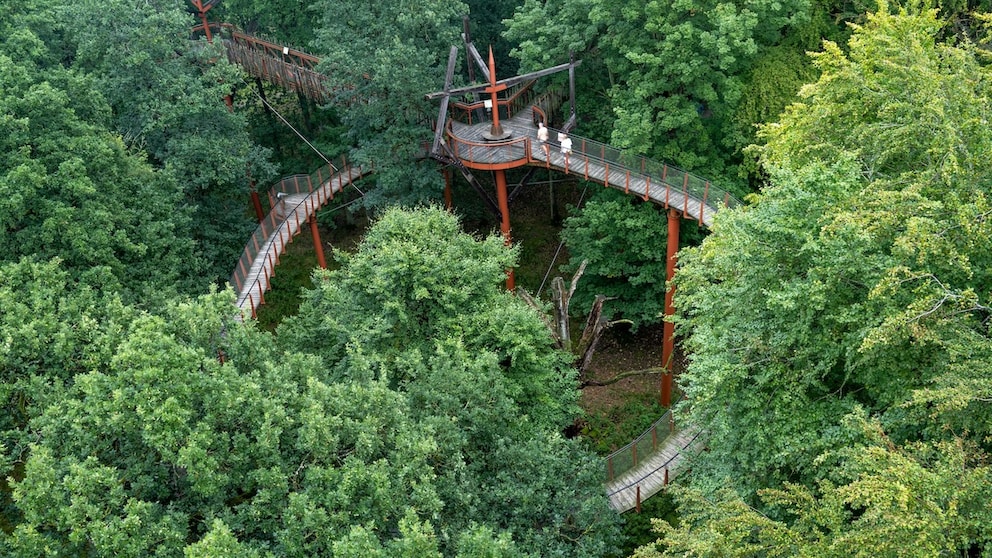
The Ivenack Oaks are such a significant natural treasure that they were declared the first National Natural Monument in 2016. They are located in the Ivenack Game Park, which, according to the “Landesforst MV” website, covers an area of more than 160 hectares and is home to about 100 wildlife species. In a fenced area of about 75 hectares, fallow deer, pigs, and even a few wild horses live. Visitors can get particularly close to the giant trees on a 620-meter-long treetop path. There is also a 40-meter-high observation tower with an elevator, an adventure trail, and a playground for children. You can rest and refresh yourself in a café. Local wild game specialties are also sold at the entrance.
Audience with the Majesties
During our visit, the forest had a very calming atmosphere. It was as if the Ivenack Oaks reminded people to take a breath on the highway of life. Everyone walked at a measured pace, almost leisurely. They stopped repeatedly to view the trees from new angles. They sat contentedly in the mild evening light. People greeted each other with a brief nod; in such a place, words are unnecessary. Much like one becomes quiet in a house of worship, here you felt as if you were in a cathedral of nature.
Those who wish to see the Ivenack Oaks with their own eyes can do so daily from April to October between 10 a.m. and 5 p.m. From November to March, the Hutewald goes into a winter sleep. Admission for adults is seven euros, twelve euros if you also want to use the treetop path. Children up to 17 years old pay three to five euros for the same package. Please refer to the official website for all rates and further information. The Ivenack Game Park is completely barrier-free.