

July 7, 2026, 3:22 pm | Read time: 5 minutes
In Kassel, you’ll find perhaps Germany’s quirkiest cemetery: the Artists’ Necropolis. Created by a participant of the famous documenta exhibition, people commit in their wills to be buried here during their lifetime–and they design their own graves beforehand.
On the outskirts of the Hessian city of Kassel, near the world-renowned Bergpark Wilhelmshöhe, lies a very special cemetery. With a wink, one might almost call it elitist, as the approximately 6,000-square-meter site is intended to hold only 40 graves. To find eternal rest here, several conditions must be met. First, a jury selects the “candidates” eligible for burial. These individuals must then commit in their wills to design their own gravesites during their lifetime.
According to the “Museum für Sepulkralkultur” (Museum for Sepulchral Culture), the idea for what might be Germany’s most unusual cemetery came from artist Harry Kramer in the 1980s. Famous for participating in documenta III in 1964, he worked as a dancer, painter, sculptor, and filmmaker during his lifetime. He believed art was often used to mask social interventions in urban structures. He feared that discontent over urban planning interventions would often be directed at the artworks themselves. What followed was a decade of disputes with authorities and environmentalists until Kramer was finally able to begin realizing his Artists’ Necropolis in 1992.
Many Artists Are Still Alive
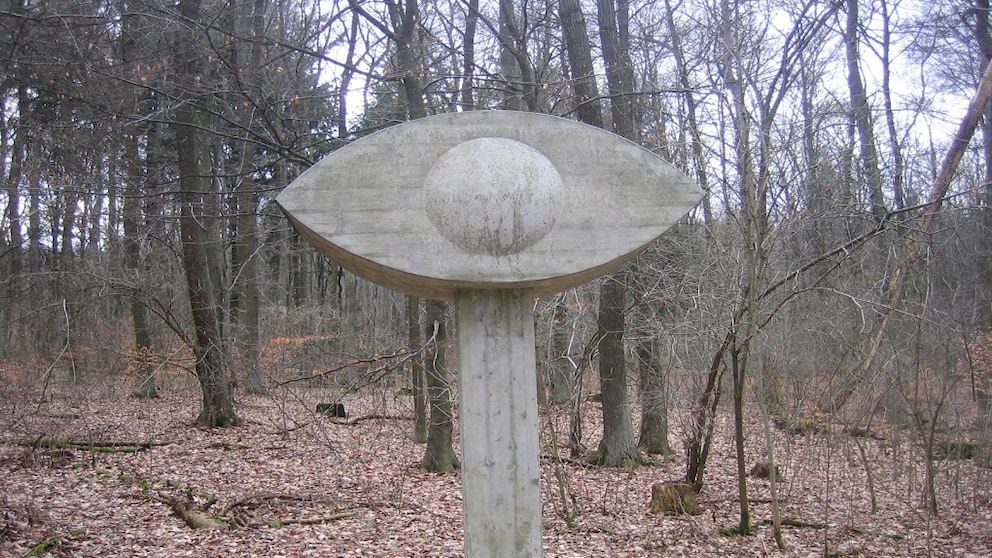
Around the Blue Lake, a former quarry in Kassel’s Habichtswald, up to 40 gravesites for artists with “documenta status” are planned, as the official site of the city of Kassel states. Ten of these have already been realized and are open to the public for viewing. A one-and-a-half-kilometer hiking trail allows visitors to explore the graves, which are, of course, also artworks. Due to environmental protection reasons, burial in urns is required, as the forest is a protected landscape area. Kramer himself has been anonymously buried in his Artists’ Necropolis since 1997.
Also interesting: The tragic story of the Sögel Tank Cemetery
Some of his “industry colleagues” have created opulent “monuments” for themselves here. The grave of Gernot Minke, born in 1937, is, for example, a walk-in dome. Particularly quirky: More than half of the people who have created their own graves in the Artists’ Necropolis, like Minke, are still alive. The late Werner Ruhnau, who passed away in 2015, had himself buried in an open-air theater and wished for it to be used for performances by living artists. Germany’s perhaps most unusual cemetery is funded by a foundation from the private fortune of the late Harry Kramer.

In Germany, you can be buried in soccer-themed cemeteries.

Hart Island: The New Plans for New York’s Saddest Place
The Inventor of the Stolpersteine

On the official website of the city of Kassel, you can download an audio guide to the Artists’ Necropolis before your visit. There, you’ll also find a map of the graves and links to the websites of the artists participating in this unusual project. Additionally, you can learn more about the significance of the individual gravesites. Besides these, there are two monuments on the cemetery grounds meant to commemorate already deceased colleagues.
Also interesting: Tower of Silence in Mumbai: The world’s most bizarre cemetery
One person who has been involved with the Artists’ Necropolis project from the beginning is Berlin’s Gunter Demnig. Today, he is a highly regarded artist known as the father of the Stolpersteine, which commemorate the victims of terror during the Nazi era in Germany. He began his career as an assistant to Harry Kramer, who was a professor at the Kassel Art Academy during his lifetime. In a TRAVELBOOK interview, Demnig recalls the beginnings: “We practically launched the Artists’ Necropolis single-handedly back then.”
Started Without Permission
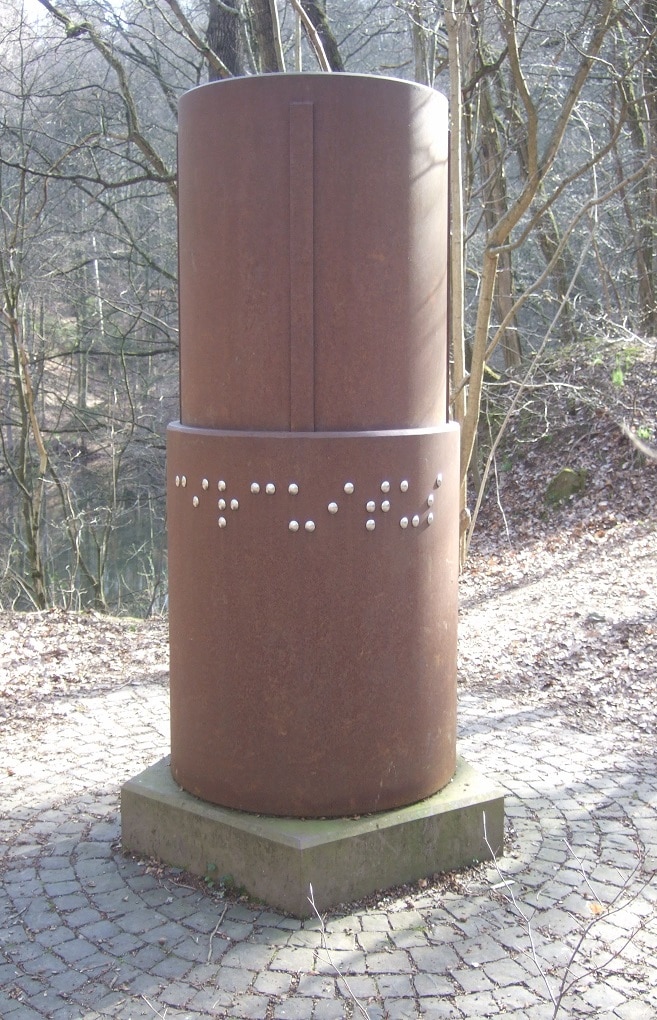
“It was extremely difficult to get approval because everyone had an opinion on it. The lower and upper forestry authorities, the monument protection, it was quite a challenge.” Demnig has also designed an art grave for himself during his lifetime, titled “Circuitus,” Latin for “cycle.” His work is modeled after an ancient water clock, like those used thousands of years ago in places such as ancient Mesopotamia.
His grave in the Artists’ Necropolis was created in 2011. “I was invited to design it back then, and my wife will one day rest beside me.” He then laughs, “It’s kind of an elite circle.” He also recalls how the Stolpersteine began. “I laid the very first one on December 16, 1992, in front of the Cologne City Hall, without asking anyone for permission. Initially, I did the same in Berlin.” Currently, he has laid 123,000 stones, each one a reminder of a fate, a life. Demnig has dedicated his own life to art, even beyond his death, with his own grave.