

November 15, 2026, 12:41 pm | Read time: 6 minutes
The small Harz village of Schulenberg in Lower Saxony was submerged in 1954 when the Okertalsperre was flooded. Its residents lost their home, which has since been referred to as Harz-Atlantis in the media. Now, parts of the lost village have reemerged due to extreme low water levels, attracting enthusiasts of lost places. TRAVELBOOK author Robin Hartmann hikes hundreds of kilometers through the Harz every year and has set out to trace the past for you.
On August 29, 1954, the world collapsed for the few hundred residents of the small Lower Saxony village of Schulenberg in the Harz. Literally, as on this day, they had to leave their home forever. Politics dictated that it should make way for the Okertalsperre project. The entire Weißwassertal would be flooded, including the idyllic village. Flooding had reached as far as Braunschweig and Wolfenbüttel in previous winters, so the Oker River was to be tamed by a 75-meter-high dam. When the reservoir began operation on August 19, 1956, Schulenberg was submerged. But now, in the fall of 2026, the almost legendary Harz-Atlantis has resurfaced.
It was the summer of 2025 when I first heard of the lost village of Schulenberg. I was on a multi-day hike through the Harz. Starting in Goslar, I passed through the new Schulenberg on the second day of my journey, where the displaced residents had been forcibly resettled. The story immediately captivated me, as here was a real Atlantis that had actually existed. I hiked around the mighty Okertalsperre and on to Altenau, imagining what the place might have once looked like. In my wildest dreams, I never expected to get even a glimpse of it just a year later.
Tracing a Story
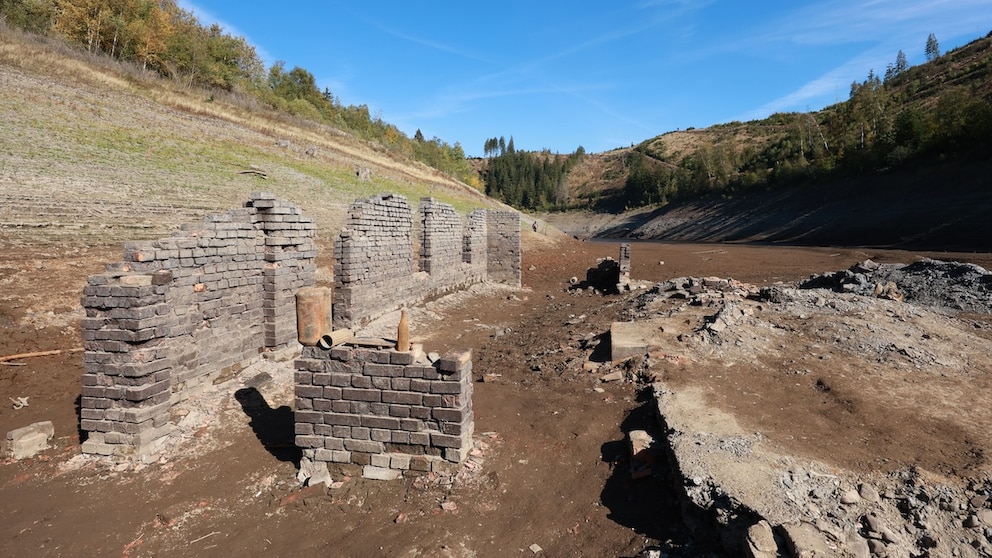
It all began when I checked my long-dormant Facebook profile after some time. Not that I had moved to a trendier platform; I just generally use so-called social media very little. Anyway, I saw a picture posted by a friend that showed little more than a few crumbling wall remnants. The story of Schulenberg came to mind again, and a quick search confirmed it. Due to extreme low water levels, Harz-Atlantis had indeed resurfaced from the Oker’s waters, with the reservoir’s capacity at just over 16 percent at the time. And this in a body of water where excursion steamers usually operate.
I had already planned to hike in the Harz again in early November 2026. One last time in freedom and beautiful solitude, covering a few kilometers before the cold and ever-shortening days forced me into a waiting position until spring 2027. And it quickly became clear that I wanted to see the ruins of old Schulenberg as closely as possible. To trace a story that is almost legendary in the region today. In the end, it was a short and surprising excursion, embedded in a lovely day tour nearby. A bit of an Indiana Jones feeling in the midst of the gray everyday life.
A Foretold Catastrophe
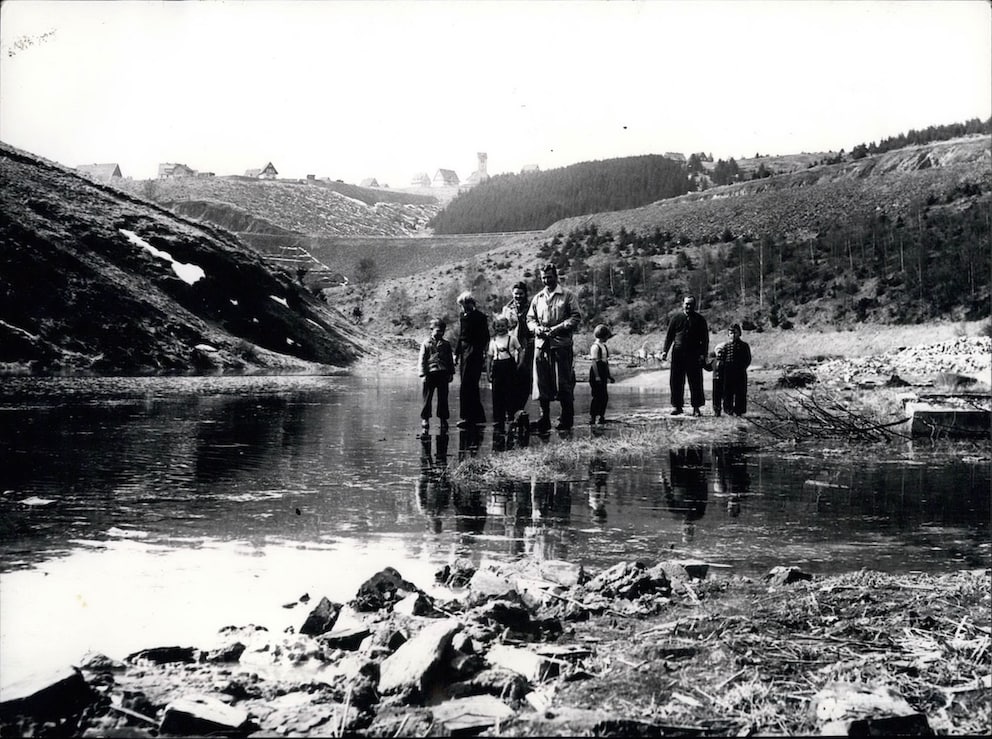
But first, back to the story of Schulenberg. According to the “NDR,” 10,000 guests were present when the nearly 300 residents of the village had to leave their home forever on August 29, 1954. Leading them was the mayor himself, guiding his uncertain flock to their new home. Sixty meters above the reservoir lies the new Schulenberg, at 490 meters above sea level, with a view of the Brocken. And to this day, overlooking the body of water that took their old village. Journalists and camera crews from all over Europe were there to report on the tragic day. Yet, the catastrophe had been looming for decades.
As early as 1928, an official letter was sent to the community leader, which was tantamount to a death sentence for Schulenberg. From that day on, no one was allowed to build in the village. Ten years later, the first workers arrived, but the outbreak of World War II granted the village a cruel reprieve. For the construction of the reservoir, 30,000 cubic meters of forest were cleared, and from 1949, the first houses in the valley were demolished. The Okertalsperre holds 47 million cubic meters of water when it began operation in 1956. The construction not only consumed old Schulenberg but also the staggering sum of 40 million Deutsche Marks.

The Little-Known Beauty of the Oker Valley in the Harz Mountains

The Most Beautiful and Wild Valleys in the Harz
Like an Abyss
Seventy years later, in 2026, it has resurfaced. Coming from Bad Harzburg, I drive with a friend into the Okertal, tracing the Harz-Atlantis. Online, there are pictures of people walking among the ruins. My friend’s daughter was recently there, recounting how she sank up to her hips in mud trying to get close to the lost place. Now I want to see the story with my own eyes. To form my own picture of the village that once sank in the floods.
Contrary to my expectations, there is no festival atmosphere on site; my friend and I are completely alone. The sun is already low as we make our way along a narrow forest path above the now almost empty reservoir to the resurfaced Harz-Atlantis. A beautiful little hike where one would normally marvel at the blue depths. But now, there is a literal yawning emptiness. Countless stumps of felled trees protrude from the valley basin, which, due to the lack of water, looks like an abyss. We think we recognize the remains of a boat. Online, it was reported that visitors to old Schulenberg even discovered vases and thermos flasks there.
Barely Healed Wounds
And then, around a bend, the ruins I had already seen on my friend’s Facebook profile actually appear. Since we are far above them, the whole thing seems far less impressive than I had hoped. But everywhere on the other shore, we discover traces of people who have obviously ventured further. The solitude and the evening silence invite a brief moment of reflection. For what we are looking at here are not just walls. These are the remnants of an old time that ended irrevocably in 1954. At the bottom of the reservoir lie not only stones but also dreams that were never lived.
A strangely melancholic mood overcomes me with these thoughts. Here, an entire place was simply erased to make way for supposed progress. My hope of meeting one of the residents of old Schulenberg is unfortunately not fulfilled. Perhaps it’s better this way. Otherwise, I might have probed into barely healed wounds out of professional ambition. And with a little imagination, I can picture it. The village that once lay there in the Weißwassertal and was home to nearly 300 people. That lived on as Harz-Atlantis after its death, and now, perhaps only for a short time, has resurfaced from the floods.