

March 25, 2026, 11:38 am | Read time: 4 minutes
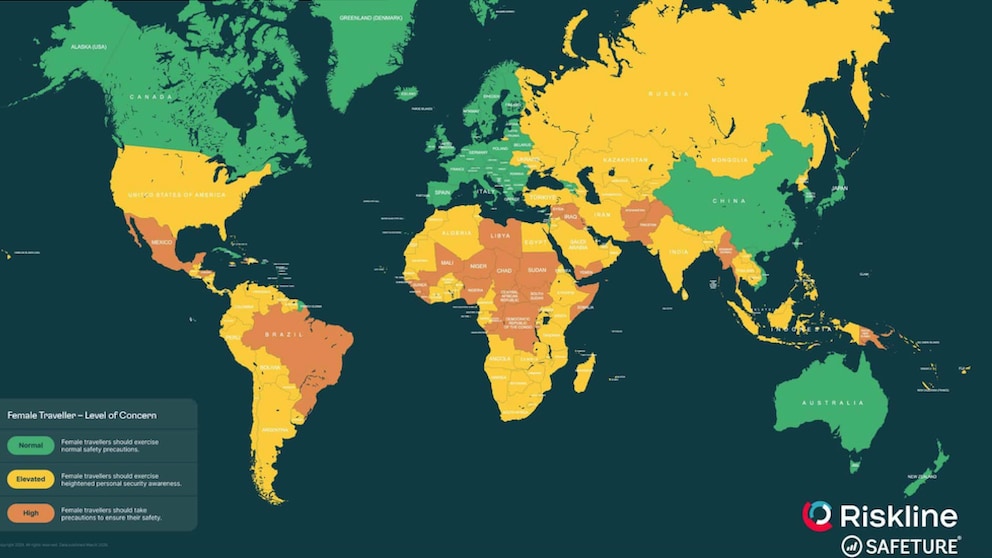
Many solo travelers are women, but traveling alone as a woman is not safe everywhere in the world. Travel safety experts from Safeture and Riskline have now released a Female Travel Safety Map, a world map showing where in the world it will be safe and unsafe for women to travel alone in 2026.
Traveling alone is often wonderful (or at least enriching), and in many places around the world, it is easily possible for women. Not without reason, 71 percent of all solo travelers are currently women. Incidentally, this is 60 percent more than three years ago, as the Swedish security company Safeture states in a release.
However, solo trips do not always end smoothly. According to Safeture, women are particularly at risk of becoming victims of “sexual harassment and assaults,” gender-specific discrimination, as well as verbal and physical intimidation. Women are also at risk depending on their travel destination due to social and cultural norms.
For this reason, Safeture, together with Danish travel safety analysts from Riskline, developed the “Female Travel Safety Map 2026.” “The map provides a quick overview of which countries women should be particularly cautious when traveling,” explains Safeture. It is intended to serve as a guide for solo female travelers as well as companies. According to the map, 29 countries worldwide pose an extreme risk for women traveling alone, and in many others, the risk is at least elevated. TRAVELBOOK presents the findings.
Methodology
According to Safeture, the map is based on three key factors. These include laws and customs that can pose a risk to women, such as local dress codes, behavioral expectations, and social norms. The second factor is safety, including harassment, sexual assaults, and general personal safety. The experts identify a third factor as health and wellness, which encompasses access to gynecological and reproductive health services, feminine hygiene products, and general health standards. Why wellness is mentioned here remains questionable. There is also no information about the individual data, sources, or how exactly the risk level was determined.
The Most Dangerous Countries for Solo Female Travelers
On almost every continent, there are countries deemed unsuitable for solo female travelers because they are considered highly dangerous by safety experts. Only Europe and Australia/Oceania are missing from the list.
These are the 29 most dangerous countries for solo female travelers according to Safeture and Riskline:
Americas:
- Brazil
- Mexico
- Haiti
- Honduras
Asia-Pacific:
- Afghanistan
- Myanmar
- Papua New Guinea
- Pakistan
- East Timor
Sub-Saharan Africa:
- Burundi
- Central African Republic
- Republic of the Congo
- Democratic Republic of the Congo
- Guinea
- Guinea-Bissau
- Liberia
- Nigeria
- Sierra Leone
Middle East and North Africa:
- Chad
- Iraq
- Mali
- Niger
- Syria
- Somalia
- South Sudan
- Sudan
- Libya
- Yemen
- West Bank
- Gaza
For these countries, travel safety experts advise all women traveling alone to take precautions for their own safety.
In These Countries, the Risk Is Elevated
A look at the women’s risk map for this year shows many yellow areas, indicating an elevated risk of violence, discrimination, etc., for women. For example, there is an increased risk in the U.S., as well as in various Central and South American countries, including Guatemala, Costa Rica, Peru, Argentina, and Bolivia. In Africa and the Middle East, there are also many yellow-colored countries, such as Morocco, Egypt, South Africa, Angola, Saudi Arabia, the United Arab Emirates, and Oman. In Asia, countries with an elevated risk for solo female travelers include Russia, India, Sri Lanka, Mongolia, Thailand, and Indonesia. The European continent, on the other hand, shows hardly any yellow areas, with only Turkey, Ukraine, the Russian exclave of Kaliningrad, and the Russian part of Europe being yellow. In Oceania, it is similar, with most island nations being yellow, but not Australia and New Zealand.
The Most Dangerous (and Safest) Countries and Cities in 2026
The Most Dangerous (and Safest) Countries in 2025
The Safest Countries for Solo Female Travelers
So where can women who want to travel alone go? Anywhere, but in these countries, their risk is lowest:
Americas:
- Canada
- Alaska (USA)
- Caribbean islands such as Cuba, Puerto Rico, Dominica, Barbados, Martinique, and their direct neighbors
- French Guiana
All of Europe, including Greenland (except Ukraine, Turkey, and Russia)
Asia:
- Georgia
- China
- Vietnam
- South Korea
- Japan
- Taiwan
- Singapore
Oceania:
- Australia
- New Zealand
How Women Can Reduce the Risk
In addition to the map, Safeture offers tips to help women at least mitigate the risks. The safety experts advise flying as early in the day as possible and avoiding nighttime arrivals. On-site, women should opt for safe, pre-checked transportation options and stay only in secure, well-connected locations. Furthermore, Safeture recommends ensuring they are always reachable via smartphone and can call for help if necessary. It is also particularly important for travelers to inform themselves about local laws, cultural norms, and the security situation before traveling.
Another tip from the TRAVELBOOK editorial team: Traveling attentively and listening to your gut feeling is essential for solo female travelers.