

June 9, 2021, 4:31 am | Read time: 5 minutes
How do I hold a nigiri, when should you actually eat the ginger, and how much wasabi does my maki need? Eating sushi can be a challenge. Especially because we tend to do a lot wrong in Germany. An expert explains how sushi is really eaten in Japan.
Ginger, wasabi, soy sauce, chopsticks: all areas where we make mistakes at Japanese restaurants. Sushi master Riccardo Blum from the restaurant Sticks’n’Sushi in Berlin reveals this in a TRAVELBOOK interview. He also clarifies faux pas that many Germans make when eating sushi. First, the terminology should be clarified. What are we actually talking about when we discuss sushi in Germany? What exactly are nigiri, maki, or sashimi?
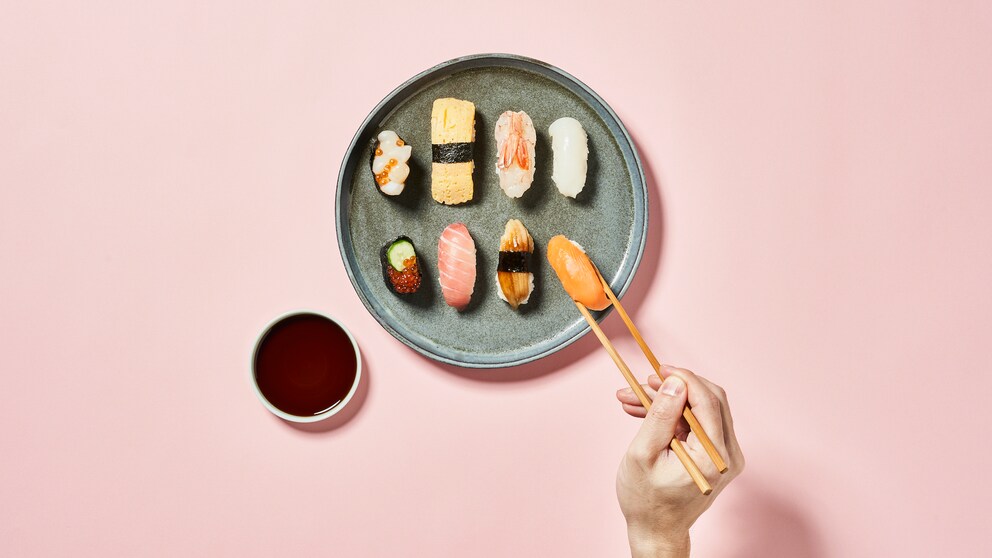
A nigiri consists of raw fish placed on rice. In sashimi, the rice is omitted, and in a maki roll, fish is rolled with rice, a seaweed sheet, and other ingredients such as avocado or cucumber. This applies both in Japan and Germany. However, some sushi that we love in Germany doesn’t exist in Japan at all.
“Stay Away from Supermarket Sushi!”
Fans of fried maki rolls will be disappointed in Japan: These rolls are rarely seen there and are even considered a no-go, as Riccardo Blum explains. Western culture is “excessive” when it comes to flavors; here, it always has to be “more exciting, exotic, and spicy.” In Japan, it’s different. The expert also rolls his eyes at pre-made maki from the supermarket. “They contain things you would probably never find in a maki roll otherwise,” he explains. An example of this is bell pepper. Also, the rice in supermarket maki is sometimes very poor if it has been sitting in the freezer for a long time.
Also interesting: Japanese ramen made at home – the recipe
But even the Japanese experience you have in a restaurant in Germany can hardly be described as authentic. “Here, we work with many sauces, which is rather rare in Japan. There, they stick to what they know,” Blum explains. The California Roll with cream cheese, so popular in Germany, is also rarely served in Japan.
Mixing Soy Sauce and Wasabi Is Considered Disrespectful
Another mistake Germans make when eating sushi is how we use the side dishes. In Germany, we are used to dipping our nigiri in a lot of soy sauce, and many add a load of wasabi and ginger on top. Some even mix the wasabi into the soy sauce. In Japan, this is not done. “It’s considered disrespectful to the soy sauce,” Blum explains.

The sauce is used quite differently there. Guests are often served only a small drop of it to ensure they use what is on the table. The video shows an impressive comparison of portions in Germany and Japan.
Also interesting: The secret of Japan’s perfectly shaped tree circles
Homemade Japanese Ramen – The Recipe
Delicious and Simple: Recipe for Vietnamese Summer Rolls
Wasabi Is Not Offered in Every Restaurant
Ginger and wasabi are also used much more in Germany than is customary in Japan. “The wasabi we get here for one plate could suffice for ten such portions in Japan,” Blum explains. In Germany, the green paste is indispensable when eating at a Japanese restaurant. However, wasabi is not offered in every restaurant in Japan. Additionally, guests there usually do not serve themselves the green paste. The chef incorporates the wasabi into the nigiri himself. “But only with the fish it actually suits,” Blum explains.
Moreover, wasabi is not just wasabi. The paste we get in Europe is usually not as high quality as in Japan. “Very, very spicy, rubbery, and sometimes chemical,” is how the paste tastes here, according to Blum, compared to the light horseradish cream used in Japan. Ginger is also enjoyed in much smaller portions in Japan. There, it is used as a palate cleanser between bites.
In Japan, only drinks that do not distract too much from the taste are served with the sushi set. “In Japan, you always get green tea with your meal,” the expert says. Sake, the Japanese rice wine, beer, and wine are also popular.
Eating Sushi Like the Japanese
To eat sushi correctly, you should dip the fish lightly in soy sauce and then turn it so that the fish lands in your mouth before the rice. A nigiri should never be bitten into; it should be eaten all at once. If you can’t fit the fish entirely in your mouth, you should at least keep the nigiri in your hand after biting and not put it down again.
Also interesting: “Sanpuru” – the Japanese hype about plastic food
The chopsticks should always lie parallel to the edge of the table; often, a small stand or stone is provided for this. Sticking the chopsticks into the sushi, maki, or nigiri or laying them across is not well-received in Japan. If you’re still having trouble eating with chopsticks, you should watch our video to learn tips and tricks from the expert.