

November 18, 2026, 9:45 am | Read time: 4 minutes
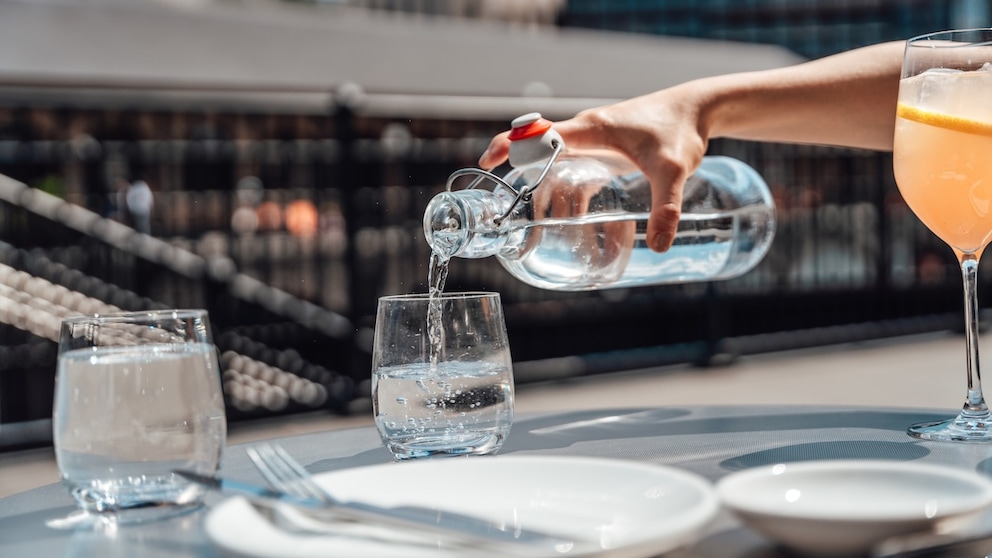
“A bottle of water, please!” You probably don’t think much about this order at a restaurant. When you order a bottle, you expect mineral water. However, you might receive a bottle of “homemade” water: table water, usually treated tap water that the establishment filters, cools, or carbonates itself. A recent inspection in Italy has shown how clean this practice is—with sobering results.
According to the Italian news portal Rai News, the Carabinieri’s NAS special unit, along with the Ministry of Health, conducted random inspections in bars and restaurants across Italy in July. Out of 272 inspections, 147 cases—54 percent—were found to be non-compliant. Issues ranged from misleading labeling to hygiene problems. Ten establishments had to temporarily close, with fines totaling around 175,000 euros.
The consumer protection association Codacons described the situation as extremely serious. “Irregularities at 54 percent are simply unacceptable, especially since it involves the basic product water,” the association stated. It called for further inspections, particularly in tourist areas.
Why Table Water in Restaurants Can Be Contaminated
For travelers, this is a good reason to take a closer look at what’s actually on the table. The difference is bigger than it sounds. Natural mineral water is bottled directly at the source, continuously monitored, and served sealed. Table water, on the other hand, is usually treated drinking water, to which minerals or carbon dioxide can be added. It can be served openly in a glass or from dispensers.
That’s exactly the crux, explains the Portuguese newspaper “Diário de Notícias.” It picks up the case in Italy and questions the state of inspections in its own country. Their explanation: Once water runs through the pipes of a device, its quality depends on how diligently the establishment changes filters and cleans carafes.
The Carabinieri in Italy criticized, among other things, dirty pipes, missing maintenance records, and serving bottles that were not sterilized. The Portuguese hospitality association AHRESP cites microbiological contamination and so-called biofilms in the pipes as risks. Such systems are considered modern, eco-friendly alternatives to plastic bottles in many establishments, which is why they are increasingly common.
Also interesting: What to Watch for When Eating and Drinking While Traveling
Tested! Where Germs Lurk in German Water Parks
11 Things You Shouldn’t Touch on a Plane
Even Tap Water Isn’t Always Safe
Since table water usually comes from tap water, it’s worth looking at the state of tap water in vacation countries. According to AOK, in Germany, France, and much of Europe, it’s considered drinkable. The Netherlands, Austria, Switzerland, and Norway are among the destinations with the best water quality.
However, the health insurance company advises against drinking tap water in some countries where you might not expect it. These include EU members Bulgaria and Romania, as well as Israel, Korea, and Uruguay. In the United Kingdom, it’s due to contamination in the domestic pipe system.
And even in Europe, the rule is: Water suppliers ensure safety only up to the end of the distribution network. After that, old house pipes can affect quality, such as lead pipes, which according to AOK, can still be found in Croatia. This applies to restaurants and bars as well: Water flows through in-house pipes, often through the aforementioned filters and dispensers. What ends up in the glass is determined at the establishment.
More info: World Map Shows Where You Shouldn’t Drink Tap Water
Water in Restaurants: What Travelers Should Keep in Mind
According to AOK, the World Health Organization (WHO) estimates that 80 percent of all travel-related illnesses are due to contaminated drinking water. Common consequences are diarrheal diseases, which according to the Foreign Office, can usually be avoided with good drinking water hygiene:
- Order mineral water sealed: In Germany, the host must serve mineral water in a sealed bottle and open it at the table. If the bottle is already open, you can request a sealed one. This is required by German law, according to Verbraucherzentrale Bayern. Natural mineral water is also regulated EU-wide, with sources monitored and water bottled in sealed containers.
- Ask what’s being served: In Germany, table water from dispensers must be labeled as such on the menu. In other travel countries, you can’t automatically rely on this. So, ask if in doubt.
- Carbonation is not a quality indicator: Table water can also be carbonated at the establishment. Therefore, the same rule applies to sparkling water as to still water: Make sure the bottle is sealed when it arrives at the table.
- Be cautious with ice cubes: In countries with uncertain tap water, they are only safe if made with clean water, according to the Foreign Office.