

June 22, 2026, 5:36 am | Read time: 6 minutes
Think you know everything about Italian cuisine? We bet there’s at least one of the following quirks you weren’t aware of. From regional specialties to culinary myths, TRAVELBOOK reveals things that might surprise even the most devoted Italy lovers.
Don’t worry: You won’t be bored with the well-known “rules” of Italian dining culture. For instance, it’s widely known that in Italy, drinking a cappuccino after 11 a.m. is frowned upon. But did you know that the way risotto is served in Italian restaurants is quite different from how it’s traditionally presented in its hometown?
Risotto Is Traditionally Served Flat on a Plate
If you think of pasta first when it comes to Italian cuisine, you might not have spent much time in Northern Italy. There, rice is just as popular, especially in the traditional dish risotto. How did this come about? It’s believed that rice likely came to Italy through Arab influences and was cultivated in the Po Valley, which remains the center of Italian rice production. And there, risotto is served in a very specific way.
An authentic risotto should “kneel” before you—meaning it should be so creamy and smooth that it gently spreads across the plate. Italians describe the desired consistency at the end of risotto preparation as all’onda (“like a wave”). This means the risotto should move in gentle waves when the pan is swirled. It should neither be too firm nor too liquid. Therefore, it is not served as a mound, as you might see in some restaurants—the risotto should not have that much structure. In Lombardy, this culinary treasure is served flat on a plate.
The Story Behind the “Cheese of the Poor”
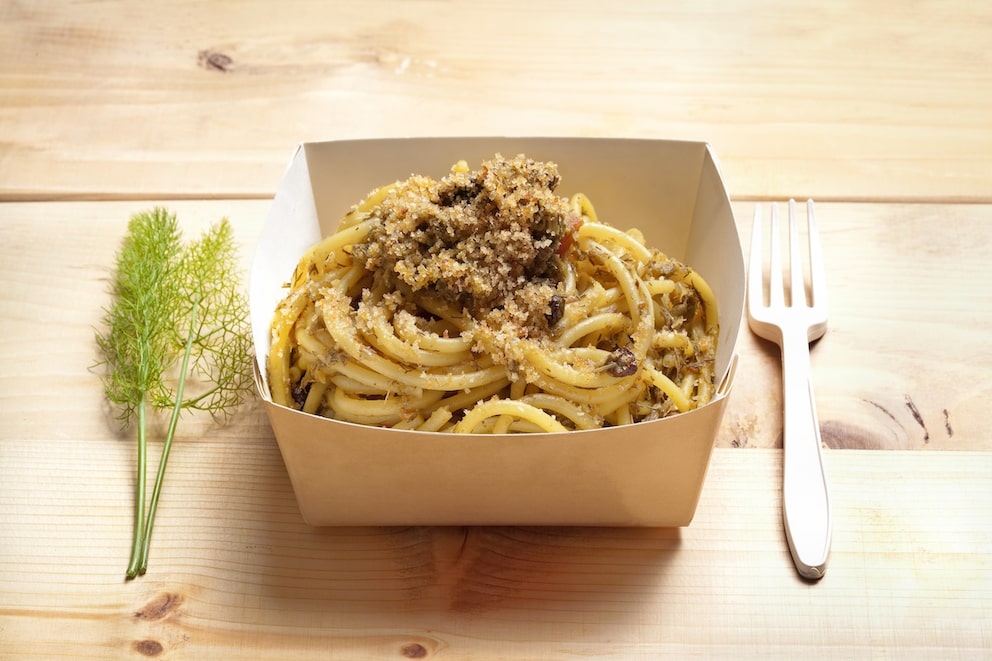
Now, onto pasta. Have you ever heard of the preparation method “alla mollica” (often “Pasta con la mollica”)? It’s a traditional Sicilian pasta dish enhanced with toasted breadcrumbs (pangrattato). These originally served as an affordable alternative to Parmesan, hence the nickname “formaggio dei poveri”—”cheese of the poor.”
You can learn more about the preparation on the website “La Cucina Italiana.” The breadcrumbs are toasted to a golden brown in a pan without fat, while garlic is sautéed with oil and anchovies in another. Before serving, the pasta (preferably spaghetti) is mixed with the anchovy mixture, then parsley and the toasted breadcrumbs are added.
Meal Times Are Not Flexible
Do you like to eat at home whenever you’re hungry? In Italy, you might run into problems, or more precisely, find yourself in front of closed restaurant doors. Traditionally, authentic restaurants take a longer break between lunch and dinner service. This happens in other countries too, but in Italy, and particularly in some regions, it’s strictly adhered to.
Most kitchens close around 2 p.m. and rarely reopen before 7:30 p.m.; in Italy, dinner is known to be eaten later than in Germany. However, night owls can still find home-style cooking at relatively late hours, meaning restaurants with generous opening hours, and don’t have to settle for a snack on the tourist strip.
An Italian Region Loves Ice Cream for Breakfast
Ice cream is probably a snack or dessert for you. In Sicily, however, it’s quite normal to eat ice cream for breakfast. More specifically, it’s about granita: a crystalline water ice available in different flavors. Traditionally, a warm brioche, a fluffy pastry, is served with it, which is dipped into the semi-frozen treat.

Would you try this “dirty” pasta dish?
Italians or Americans: Who Really Invented Carbonara?
Italians “Eat Everything”
“We’re like the Chinese: We eat everything!” With these words, the chef of an osteria in Cremona served TRAVELBOOK a dish with veal sweetbreads and tongue during a research trip. He wasn’t wrong. While offal is mostly found in a few classic dishes like liver, kidneys, heart, or tongue in Germany, it still holds a much higher status in Italy and is even a central part of Italian cuisine.
The origin of this food culture lies in the concept of Quinto quarto (“fifth quarter”). As explained in the standard work “The Oxford Companion to Italian Food,” a slaughtered animal was once divided into four high-quality quarters, which were mainly reserved for wealthier populations. The offal and other less desired parts formed the so-called fifth quarter. They were cheaply available and served as an important protein source for the poorer population.
Fascinating Cucina povera
Out of necessity, a distinct culinary tradition developed over time: Cucina povera. With creativity and craftsmanship, dishes made from simple ingredients emerged, which are now considered regional classics. Even in a ragù alla bolognese, offal can find its way in, depending on the region and recipe. Against this backdrop, the remark from the host in Cremona takes on a second meaning, as in Italy, using as many parts of the animal as possible is still considered good cooking, not a culinary exception. And strictly speaking, even a third.
These Strict Rules Apply to Pasta
You’ve heard enough that Parmesan or cheese is “not allowed” on pasta with fish or seafood. Although it’s worth mentioning that there are now bold culinary rebels who defy the strict principles of authentic Italian cuisine and offer the combination anyway.
In other areas, however, rules are strictly adhered to. Traditionally, pasta is not a main course but a primo, a first course—and never a side dish! And when it comes to the shape of the pasta, the choice is not based on personal preference but on the sauce served with it. If it’s heavy and chunky, short noodles are suitable; for fine, liquid sauces, long, thin noodles are the right choice.
Returning to the aforementioned meat sauce, the spaghetti Bolognese so popular here doesn’t actually exist in Italy. Giorgia Zabbini from the Bologna city administration—the city that gave the sauce its name—confirmed this in a conversation with TRAVELBOOK. A ragù alla bolognese goes well with “all kinds of pasta, but not with spaghetti.” Tagliatelle, flat egg noodles, as traditionally served in Emilia-Romagna, are a much better match.